
What our clients actually built with AI agents on top of Campaignswell
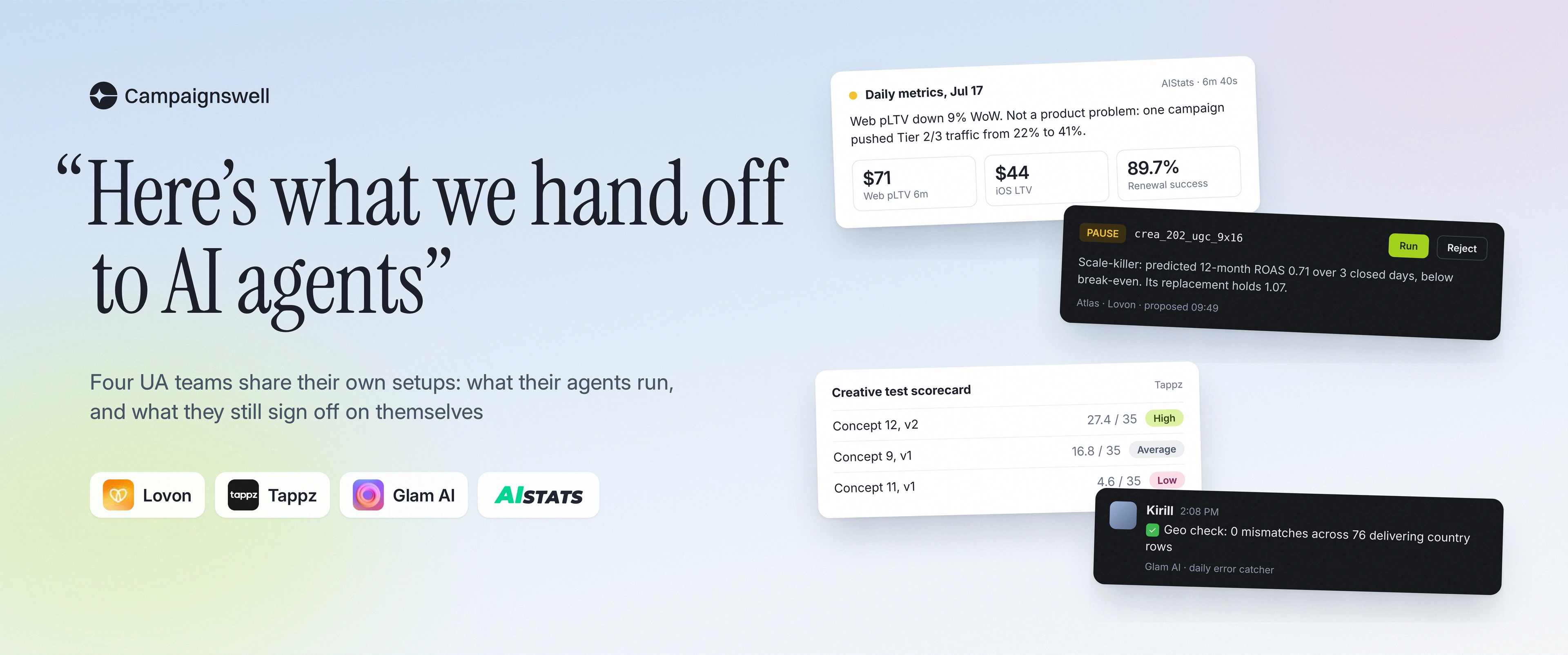
Scroll LinkedIn for five minutes and you'd think every UA team has already handed its job to AI agents. Hard to tell what's real and what's just a nice post. So we skipped the posts and asked four Campaignswell clients what they actually run every day, with Claude or ChatGPT plugged into their data through our MCP. Turns out it's the boring, repetitive parts of UA:
- cutting losing ads and moving budget on Meta,
- scoring creative tests,
- catching broken campaign settings and funnels,
- the morning check of LTV, ROAS and refunds.
And these aren't side projects: some of the teams spend up to $2.5M a month on ads.
Below is what each of them built, what they learned along the way, and where they still keep a human in the loop.

Lovon: an AI media buyer called Atlas
Anton Ponikarovskii is a co-founder of Lovon, an AI support coach sold through web funnels. Almost all of the spend goes to Meta, hundreds of thousands a month, and Anton runs the UA himself.
His take: a media buyer's day is the same loop over and over. Read the money, cut losers, add winners, move budget. Every day it's the same four steps. The only thing that changes is the numbers, and that's exactly the kind of work you can hand to an agent. A person runs that loop once or twice a day, by hand, on whatever campaigns there's time for. Atlas, their agent, runs it on every live campaign every 6 hours and checks new creatives every hour.
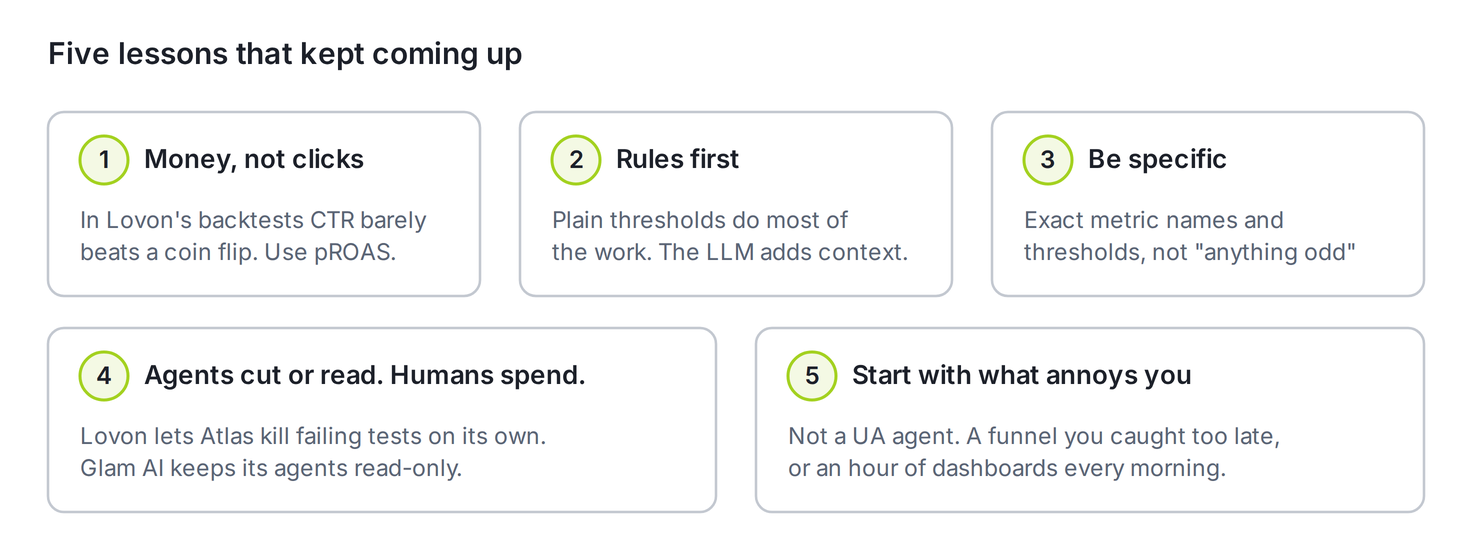
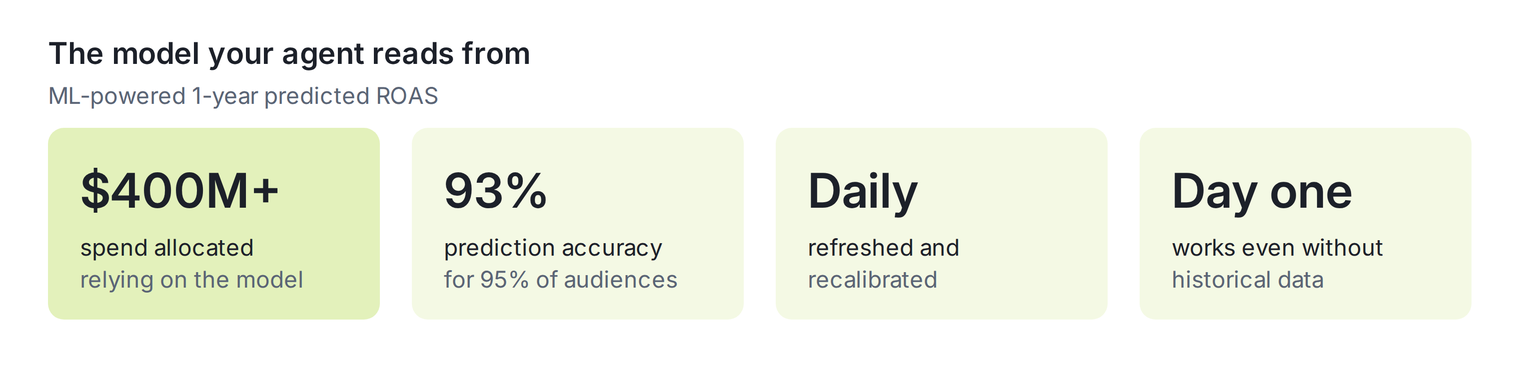
The money signal comes first. Atlas decides on predicted 12-month ROAS per ad from the first day of spend, and gets it from Campaignswell MCP. Before trusting any metric, they backtested how well each one picks future winners. CPM and CTR are barely better than a coin flip.

On every pass Atlas asks three questions:
- Which creatives and campaigns pay back?
- Did anything change since the last pass? If nothing moved, it skips the analysis.
- And is this a bad day or a real drop?
For that one it compares each day with the same weekday last week.
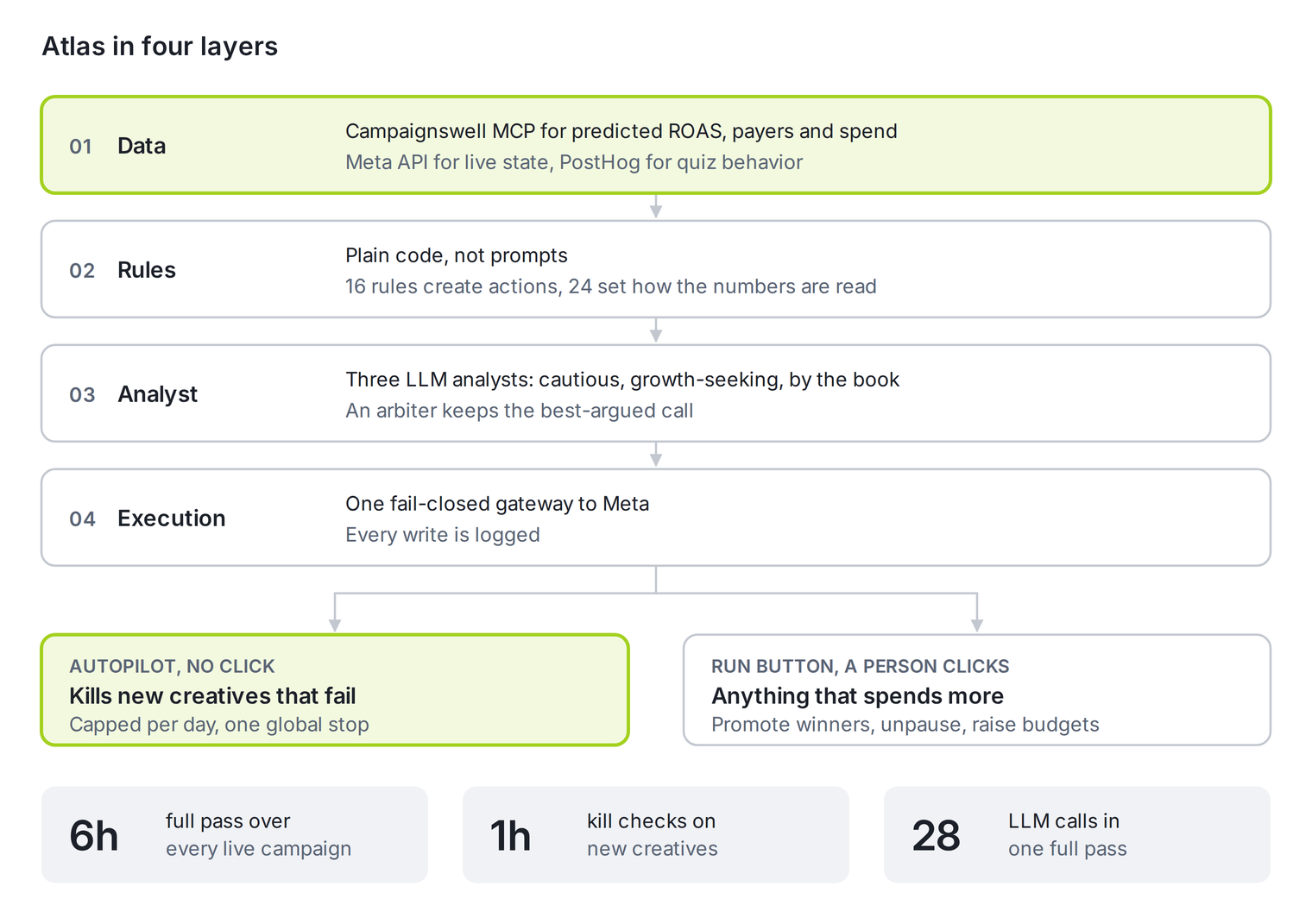
The prompt argues, the code decides. The prompt is a 100 KB playbook that tells the model it's the UA director and owns the P&L. A few lines from it: "Let's wait" is not an answer while money bleeds. No action on fewer than 5 payers. Judge recent money, never lifetime. But the model never touches Meta directly. It fills in a form and code runs it, so free text never reaches the ad account. If the model forgets to cut a loser, code adds the cut. Moves on the wrong ad set, funnel or language get blocked, and budgets only move in small steps.
Agents cut, humans add. The only thing on autopilot is killing new creatives that fail: dead CTR, zero purchases, or pROAS under break-even at a spend step. Replayed on past creatives, those early checks killed zero future winners. Anything that spends more waits for a person to click Run. When someone reviews Atlas, 4 of 5 proposals get approved as they are. And in the cases where a person blocked a cut, Atlas turned out to be right 5 times out of 6.

So Atlas now makes 9 of 10 calls on running campaigns, up from about 4 in 10. ROAS went up, and the whole setup costs about $1K a month. Every change in the ad accounts, by Atlas or by a person, is logged with who, when and why. That's how the rules keep improving: every change is tested on past data before it goes live, a new rule gets added where the log shows a missed move, and a rule that does no better than a random cut gets dropped.
Next to Atlas there's Iris, a creative agent. It picks Lovon's best creatives and competitor ads that keep running, takes them apart second by second (setting, person, hook, message), writes designer briefs that change one thing at a time, checks the designer's upload and ships it to Meta. Atlas tests the new creatives on money, and every winner becomes Iris's next starting point.
Tappz: a 7-person marketing team that built its own BI
Tappz is a 20-person startup from Germany, competing with companies the size of Google. Tanya Kovalevska is the Growth Lead and also owns monetization of the web channel. There was no BI, just copy-pasting numbers between spreadsheets and never being sure if they were overspending.
With Claude and Campaignswell MCP they built five small tools.
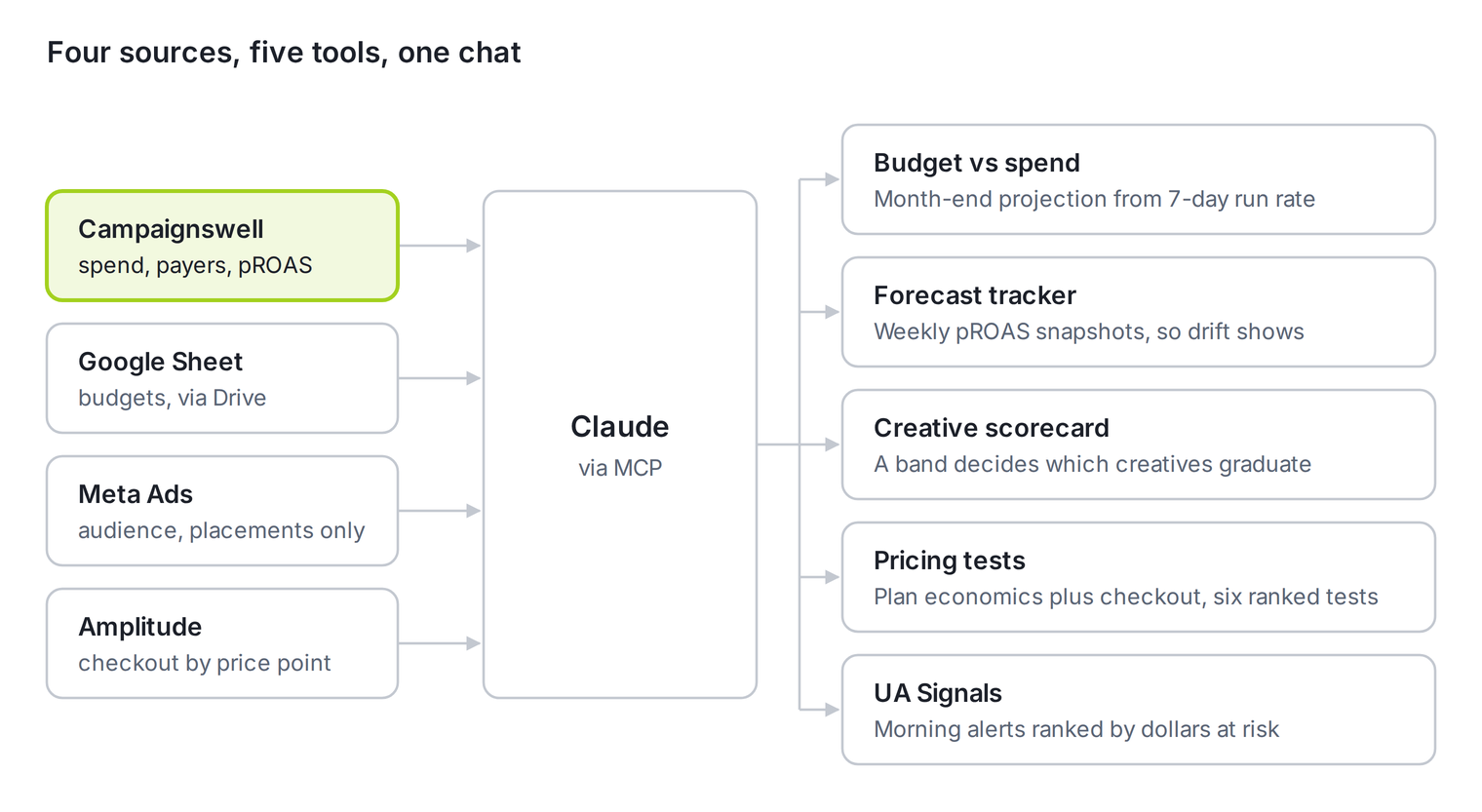
Budget vs spend. Budgets live in a Google Sheet, spend lives in Campaignswell. Claude reads both per app and channel and projects month-end spend from the last 7 days' run rate, so an overspend shows up mid-month instead of on the invoice. It replaced a monthly copy-paste of channel spend into the budget sheet.
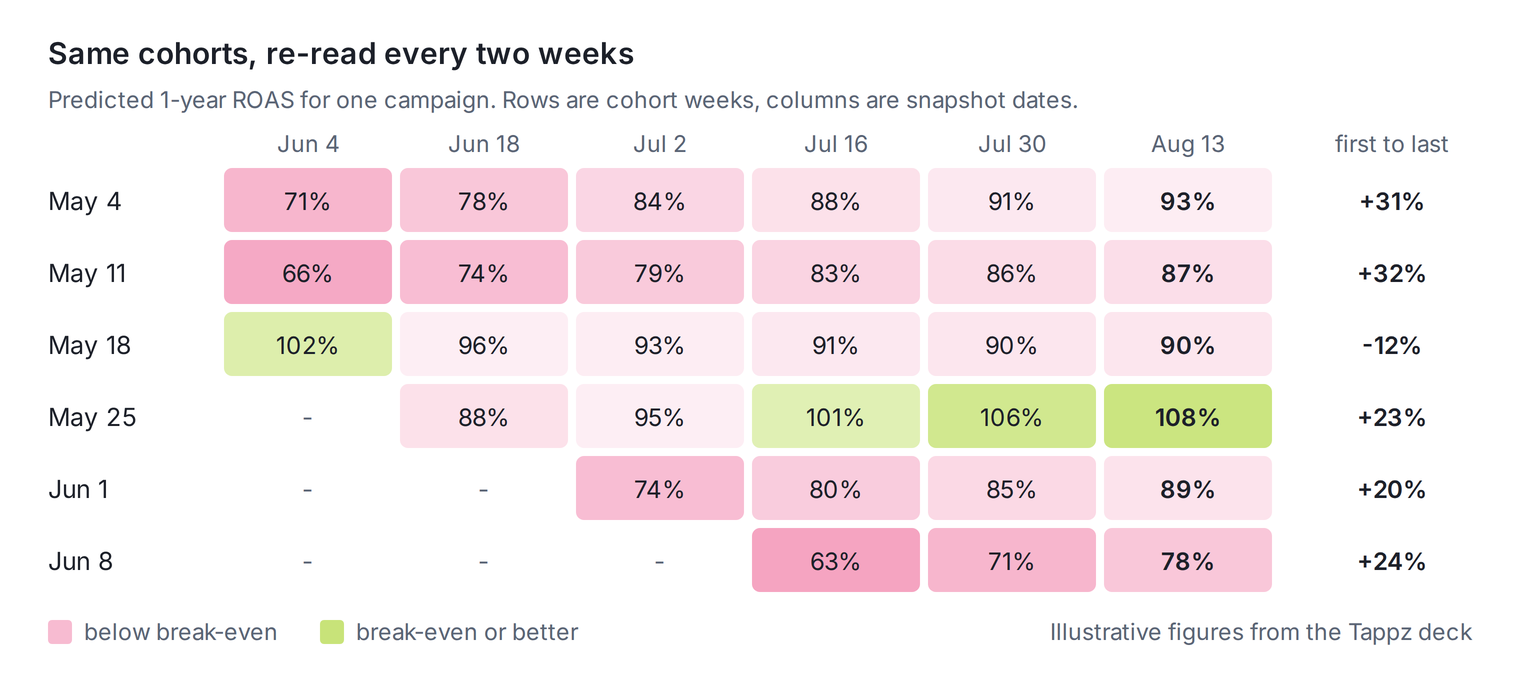
Forecast tracker. Campaignswell shows the current predicted ROAS for a cohort, so when a forecast gets recalculated, last week's reading is gone. Tappz runs a weekly task that saves a dated snapshot of 1-year pROAS per campaign and cohort week and never overwrites it. Now they can see how far each campaign's forecast usually moves and weigh an early reading against that history before it drives a budget call.
Creative scorecard. Each test creative is benchmarked against comparable live creatives from Campaignswell: same country and network, a spend floor, the test campaign excluded. The band decides what graduates to live campaigns, not a single metric. Their UA manager Ernest built the Meta part of this and writes about it in his Telegram channel @kit_in_china.
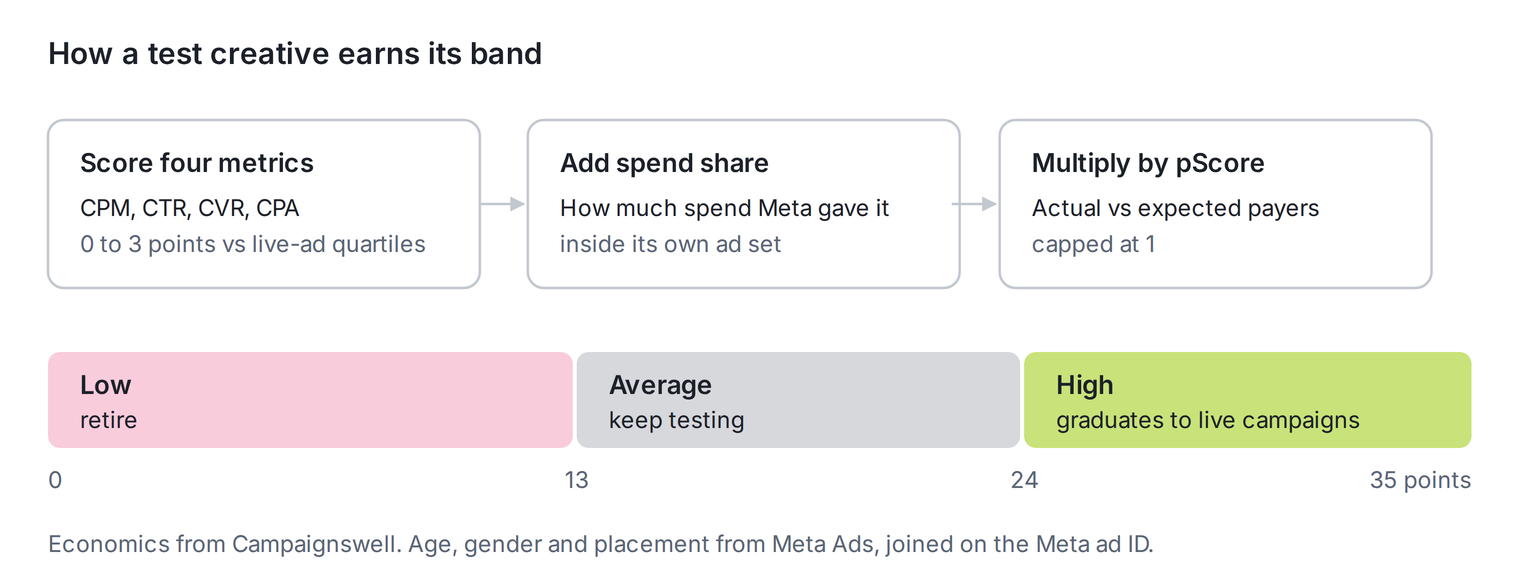
One lesson from that join: Meta bills in EUR and attributes its own way, so its numbers never match Campaignswell. Meta only supplies the shape of the audience split. Spend and payers always come from Campaignswell.
Pricing tests. Tanya asked Claude one question: which price tests should we run next? Claude pulled plan-level economics from Campaignswell (pLTV per payer, how many are still subscribed, churn, refunds) and checkout behavior by price point from Amplitude, joined them, and came back with six tests ranked by expected impact. The result is a playbook the team reruns after every test. Tanya is honest about it: she doesn't fully trust it yet, but it reached the same conclusion she did after two hours of digging, and she's already running a test based on it.
UA Signals. Every morning three Campaignswell queries compare the last two days with a 14-day baseline. A spend drop of 40% or more, or CPA moving 15% in either direction, becomes a signal priced in dollars per day. Anything under $50 a day is dropped. There's no database: the bot posts a JSON snapshot as a reply to its own message and reads the last three back to mark streaks. It catches wins too. A sudden CPA drop is either worth scaling or a tracking bug, and either way the team looks at it the same day.
Glam AI: the cheapest setup on this page
Kirill Marenkov, Senior UA manager at Glam AI, opened with: "I'm not an AI-native guy." Every time he tried to start, he'd dream up some huge agent and end up building nothing. So he went the other way.

The error catcher is the simplest idea on this page and probably the most copyable: the campaign name is what you meant, the settings are what you actually set up, and the agent checks that they match. It reads the name and yesterday's delivery data from Campaignswell MCP. The copy helper works in three modes: give it images and it writes copy, give it a CSV and it only updates what it knows about winning and losing copy, give it both and it does the learning first, then the writing.
His rules fit on one slide:
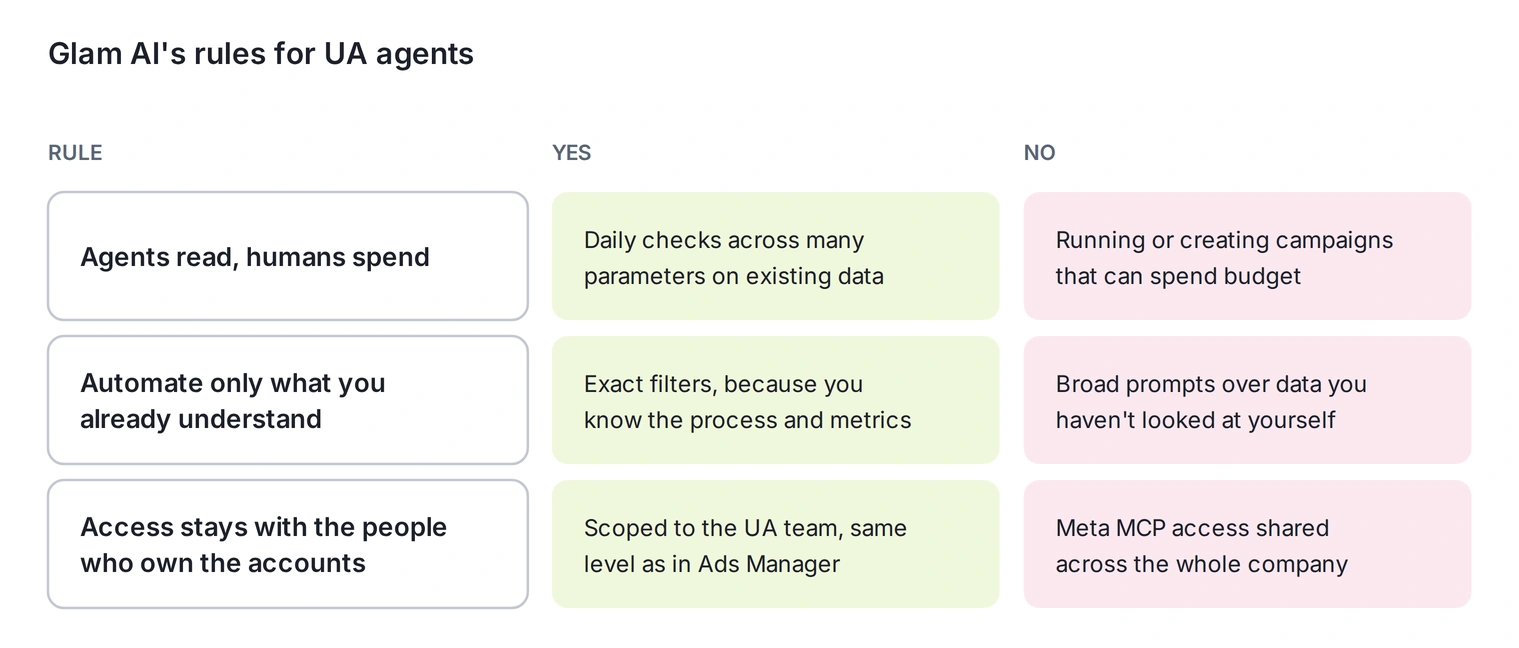
The last one is about security. A Meta MCP connection can launch campaigns, so if it leaks or is shared too widely, someone else can spend your money.
AIStats: a growth analyst that shows up at 9:30 every morning
Vlad Sakharov, Growth PM at AIStats ($10K+/day ad spend), got tired of spending an hour every morning clicking through four dashboards. So he wrote a scheduled Claude task that does it instead.
Every morning it pulls 30+ metrics across the web funnel, iOS and Android. About 85% come from Campaignswell (pLTV, pROAS with confidence intervals, renewals, churn, card mix), the rest from Stripe, RevenueCat and PostHog. It checks everything against red and yellow thresholds, writes a Notion page and sends a one-line Slack message. Under 8 minutes, nobody involved.
The part that makes it useful isn't the numbers, it's that every flag comes with a reason.

The hour saved is nice. The real win is that a refund spike or a broken payment flow shows up the next morning, not a week later as a hole in revenue. And since every day is one Notion page with the same structure, "when did refunds start climbing" takes one scroll.
His main lesson, learned the hard way: treat the prompt like production config. When the prompt said "find the LTV metric", half the metrics came back missing. Now every column name is checked once and hardcoded, thresholds are explicit, and there's a defined plan for when a connector fails.
By the way, Vlad shared the whole thing. You can grab the Daily Metrics Monitor skill and set it up in an afternoon. It comes with the full prompt, a column map for Campaignswell, flag thresholds, an investigation playbook for each flag, and the Notion report layout. Swap in your org ID, LTV floors and refund ceiling, and tomorrow morning the report is waiting for you. If you use Adjust, Paddle or Amplitude instead of their stack, the file marks exactly what to replace.
What kept coming up
Lovon lets an agent pause ads on its own, while Glam AI keeps its agents read-only. A few lessons still showed up in all four setups.
One thing nobody's giving up yet: the dashboard. Dmitrii Solomakin, Head of Web at Talaboos, said in the discussion that he still opens the Campaignswell UI pretty often. You get the overview first and dig into segments fast, without waiting for an LLM to answer. And MCP output doesn't always show cohort size or how old a cohort is, which you need before making a call.
Want to try this yourself?
Campaignswell MCP works with Claude and ChatGPT. Everything you see in our dashboard, cohort predictions, pLTV, pROAS, renewals, churn, is available to your agent too. That's the money signal Atlas decides on and the one AIStats pulls 85% of its metrics from.
You don't need a $1K/month setup. Connect the MCP, pick one thing you check by hand every day, and ask Claude to check it for you.
Book a demo with Campaignswell

Co-founder & CEO at Campaignswell
Book a demo


Co-founder at Campaignswell
Use the session to ask your hardest questions about scaling, LTV, or attribution, and see how full-funnel predictive analytics gives you clear, actionable answers.