How an AI Companion App drove 10x revenue growth with SaaS BI Campaignswell

Picture this: you’ve built an app that truly resonates with users. Users keep coming back, engagement grows steadily, and every metric signals it’s time to scale. The team’s experienced, ambitious, and ready to make the next big step, but the data foundation can’t keep pace. Dashboards tell different stories, agencies and finance speak in different metrics, and the full picture of performance never quite comes into focus.
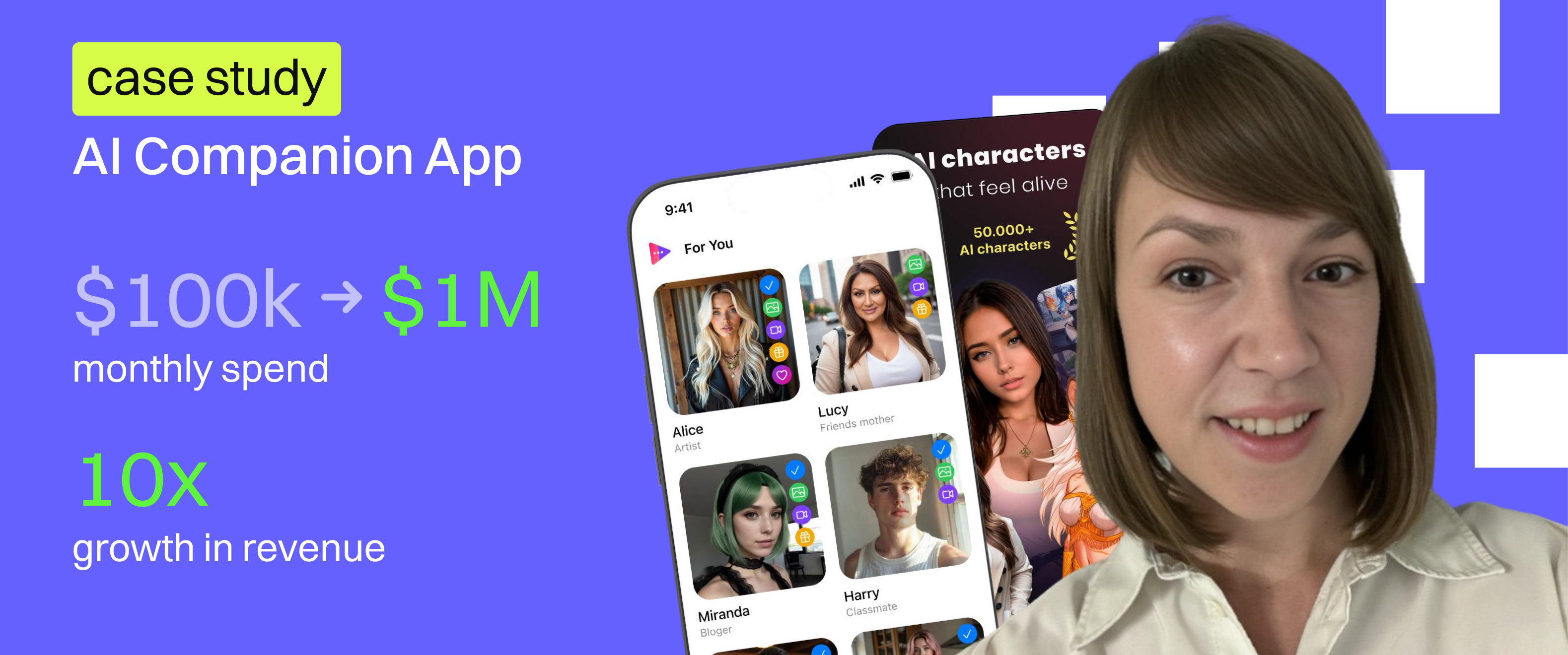
That was the situation for Dialogue AI — a subscription-based AI companion app that combines conversation, entertainment, and emotional connection. The product had strong traction, but fragmented reporting made it challenging to get a consistent view across paid channels.
Fast forward a year: Dialogue AI turned that clarity into action — achieving 10x growth in revenue, subscriber base, and profitability. Here’s how Campaignswell helped a high-performing marketing team get the clarity they needed to scale faster and smarter.
Before
- Data split across multiple dashboards (in-house + agencies + mobile + web), each with its own logic → no consistent view
- Manual reporting ate hours every day
- Conflicting performance reporting (no single source of truth)
- $100K/month Ad spend, but revenue insight lagged behind spend
- High-volume landing tests, low insight: no fast LTV signal by landing
With Campaignswell
- One dashboard for web + app + agencies (same TZ/currency, net revenue)
- Fresh data several times/day (quick cohort checks)
- Landing tests with guardrails: pLTV + D1/D3/D7 signals to scale/kill
- Cross-platform attribution: web → in-app pay tracked correctly
- 1 year: 10× spend ($100K → $1M/mo), 10× revenue, 10× subscribers, 10× profit

[[ctaform1]]
When manual reporting slowed decision-making
Dialogue’s marketing system was active and diversified, but not yet fully scalable. The team operated a hybrid UA model — combining in-house traffic with agency partnerships and expanding from mobile into web acquisition funnels. Each data source had its own configuration and reporting logic. While everything worked, syncing data across platforms required additional alignment to maintain accuracy. As Irina, Dialogue’s CMO, put it: “We realized early that fragmented data doesn’t just slow reporting, it slows growth. Unifying our data wasn’t a technical task, it was a strategic one.”
Performance data was manually compiled each day from multiple dashboards. Manual reconciliation took hours and introduced uncertainty. Budgets of around $100K per month were in play, but revenue insights lagged behind spend. “It was a significant investment,” Irina recalled. “We were testing fast, learning fast, and figuring out what would scale.”
The team knew exactly what to do; they just needed one analytical system fast enough to match their pace. “One report told us profit, another loss. Which do you trust? Neither.” Hiring a dedicated analyst was considered, but past experience showed that building internal BI would take at least six months before anything usable appeared. Six months they simply didn’t have, with Q5 approaching fast.
This was a classic scaling moment: the team already had traction, expertise, and resources, but needed a reliable, real-time layer of truth to keep growing at pace.
At the crossroads: build BI from scratch or choose SaaS BI
The team already knew what kind of solution could solve the problem — a solid BI system that would bring all their data together. They had seen this challenge before and knew how much time and effort it could take to build internally. Irina remembered it clearly: “In my previous startup, it took us six months with a very strong engineer just to build a partial solution. We ended up back in Excel anyway.” With Q5 approaching, there was no space for another long experiment. What they needed was clarity they could rely on — right away.
What the team asked for was specific:
- Single source of truth across mobile and web, with one analytical time zone and unified currency.
- Consistent, channel-level clarity when advertising sources became less reliable due to attribution changes.
- Web funnel readiness because the team was launching dozens of landings a week, often with pricing and payment experiments, and needed landing-level LTV signals fast.
- Cross-platform stitching so web users who later paid in-app were still attributed correctly.
- A prediction layer they could compare with their own assumptions to de-risk aggressive scaling.
That’s when Campaignswell entered the picture. Irina described the choice:
“It was roughly the same cost as hiring an analyst, but the platform was ready immediately. We could always bring an analyst later — once the foundation was in place.”
Integration: how the first month set the stage for scale
Integration started with connecting all key sources of truth. Ad accounts from Facebook, Google, and TikTok were linked, along with the agency’s systems and Dialogue’s in-house user acquisition. Then came the web funnels: dozens of landing pages needed to be stitched so that user journeys were tracked from first click through to in‑app payment. Attribution logic was set to unify mobile and web into one analytical time zone, with revenue validated against subscription payments.
The first month was dedicated to this setup: correcting broken links, aligning attribution rules, and ensuring VAT‑inclusive revenue calculations matched finance. Once the pipelines were clean, Campaignswell began refreshing data several times a day, giving the team a real‑time view across all channels.
From the second month, the foundation was solid. The team leaned in fully, checking dashboards daily, and plan‑vs‑fact comparisons became a regular habit. As CMO put it: “The platform gave us daily confidence in our data. That confidence let us take the risks you need to grow.”

How clear data reshaped funnels and profit
With a single source of truth and a predictive layer in place, marketing stopped feeling like guesswork and started operating on signal. Here’s how day‑to‑day work actually changed across teams and channels:.
1) Scaling with pLTV, not hope
Dialogue’s marketing team began each day by checking predicted LTV against CAC and their chosen payback horizon. “Every day we reviewed predicted LTV vs actual… it convinced us we were on the right track,” Irina shared. The team chose which LTV month to work toward and took calculated risks when the model showed headroom. That confidence was the difference between inching forward and stepping on the gas.
2) A landing‑page factory with real guardrails
The web funnel “factory” was shipping dozens of landings per week. These weren’t just design tweaks; they tested pricing and payment methods too — high‑risk moves that can flip ROI in the moment. Instead of running a landing for months to know if CPA held, the team watched landing‑level pLTV and churn curves in days: day‑1, day‑3, day‑7, and beyond. If the signal looked stable, they kept tempo; if not, they cut fast. “We sprint, we launch all tests in parallel,” Irina said.
3) Web and app stitched into one story
Cross‑platform linking meant web subscribers who later purchased in‑app were still counted in the same funnel view. That clarity validated a big strategic bet: the product could live on web, not just mobile.
4) Agencies in the same cockpit
Agencies and in‑house UA finally shared the same reality: one attribution method, one time zone, unified currency, and VAT‑clean revenue. Bringing partners into the same dashboard ended the “flights/underflights” debates and sped up decisions.
5) iOS visibility with SKAN modeling
iOS had been a blind spot. Probabilistic modeling reconstructed missing attribution, redistributing “organic” back to the paid sources driving it. That gave familiar breakdowns by channel and creative again and even reopened classic app‑to‑app campaigns. Early observations suggested mobile and web reinforced each other; SKAN traffic appeared to lift web conversion through brand and attention effects.
6) Cadence: real‑time enough to matter
Data was synced multiple times per day, so UA could check cohorts 10–20 times daily when needed. A daily plan‑vs‑fact table tracked prediction accuracy; weekly, the broader team reviewed LTV trends — “our heart rate,” as Irina called it. This rhythm turned anomalies into investigations instead of end‑of‑month surprises.
7) When LTV drops, dig, don’t panic
Mid‑scale, predicted LTV fell. Instead of slamming the brakes, the team treated it as a trigger. Analysis revealed a new audience with lower early value but strong long‑term potential. Product adjusted content and flows, and that cohort grew into a top‑three profit branch. The bigger lesson: a drop can be a door, not a dead end.
8) From broad audiences to real segmentation
Before Campaignswell, Dialogue treated its users as a single homogeneous group. With the platform’s cohort analysis, they began to see clusters of audiences with very different behaviors. Some sub-segments looked unpromising at first glance but later turned out to be highly profitable. “Campaignswell unlocked a new level of audience intelligence for us. Before, we didn’t have real segments, just a general user base. Now we can identify clusters and high-value sub-segments, which gave a major boost to both marketing and product,” Irina said.
9) From scattered spreadsheets to scalable growth
Early budgets hovered around $100K/month, and every decision required careful validation. With unified data and prediction, the company scaled 10× across spend, subscribers, and monthly profit over time. Irina is frank about the attribution of credit: it wasn’t one tool alone, but without trusted data and forward‑looking signals, “guesswork” would have capped growth long before that.
In practice, Campaignswell became the common language for UA, product, creatives, and agencies. Tests launched faster, bad ideas died sooner, and winners got budget before momentum faded. Most importantly, the team stopped arguing about numbers and started executing on them.
[[ctaform1]]
The impact: 10x growth, powered by clarity
Looking back, Irina is clear: “Sustainable growth requires reliable data. Without this platform, we wouldn’t have made this jump so fast.” The decision to skip a custom BI build and go with SaaS BI saved half a year of engineering effort and close to a million dollars in sunk cost. Instead of waiting for dashboards to slowly take shape, the team had actionable data in weeks.
Three lessons stand out:
Speed beats perfection. Building BI in‑house may look attractive, but by the time it’s stable the market has moved. SaaS BI gave Dialogue AI usable insight immediately, so they could hit Q5 ready.
Marketing needs its own tools. Generic BI stacks bend toward finance or ops. Here, UA managers, product owners, and creatives got what they needed in their own language — LTV, funnels, cohorts, creatives, and so on.
Scale demands clarity. At around $100K per month in spend, fragmented visibility limited further growth. Once the team moved to a unified stack, they gained the confidence and precision to scale to millions in both spend and profit. The ceiling lifted instantly.
It’s also about resilience. iOS privacy changes, agency debates, and risky web experiments will keep coming. What changed is how Dialogue’s team reacts: with one shared source of truth, surprises turn into signals.
As Irina put it best: “The platform gave us daily confidence in our numbers, empowering us to take the kind of risks growth requires.”

What if they had built BI from scratch?
It’s worth pausing to imagine the alternative path. A custom BI build would have meant six months of engineering before seeing anything usable, plus close to a million dollars in sunk costs. During that time, UA teams would still be stuck in spreadsheets, agencies would still argue over attribution, and Q5 opportunities would have passed them by. By the time dashboards were finally stable, the market would have shifted again.
What Campaignswell brings instead
Campaignswell is SaaS BI built specifically for app marketers. It unifies app, web, and agency data into a single source of truth, validates revenue against real payments, stitches journeys across platforms, and layers predictive LTV on top.
In Dialogue’s experience, the value went way beyond UA: marketing, product, and finance teams all now use the same platform as their source of truth.
<highlight-pink>Ready to see how your app could grow bigger, faster, and safer?<highlight-pink>
Book a demo with Campaignswell
and explore how the right data stack makes scaling far more predictable.

Co-founder & CEO at Campaignswell
Book a demo


Co-founder at Campaignswell
Use the session to ask your hardest questions about scaling, LTV, or attribution, and see how full-funnel predictive analytics gives you clear, actionable answers.


.webp)