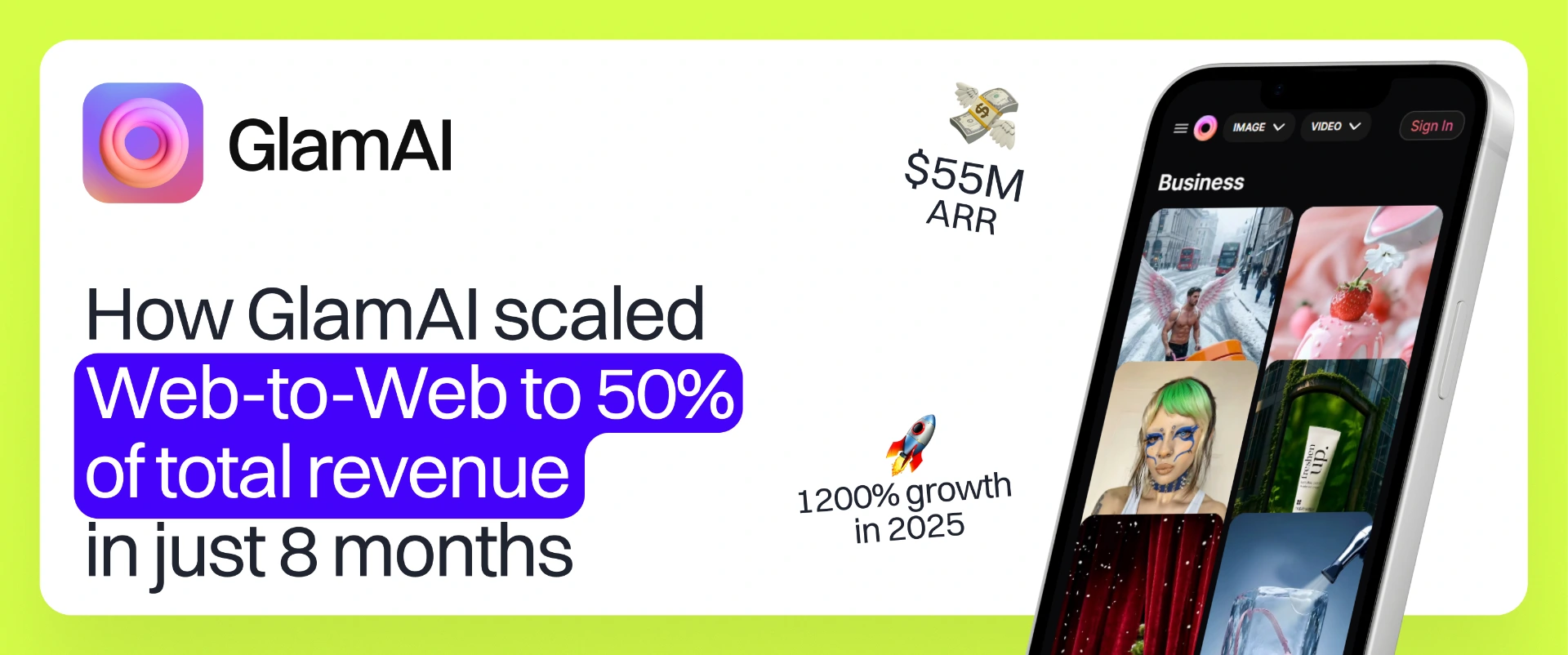
How this AI Consumer App scaled Web-to-Web to 50% of total revenue in just 8 months
Before
- Web-to-web launched as an experiment, not a core growth channel
- Revenue tracked at transaction level, but no long-term value visibility
- Manual LTV forecasting → overly conservative scaling
- Profitable campaigns under-scaled due to low confidence in predictions
- No clear connection between creatives, funnels, and long-term value
With Campaignswell
- Unified view of ad spend + revenue + cohorts in one place
- Structured renewal tracking and predictive LTV by cohort
- Scaling decisions based on payback and pLTV, not early CAC noise
- Creative and funnel optimization guided by long-term value
- Clear attribution from acquisition to accumulated revenue
- 30× monthly web-to-web budget scale ($60K → $1.8M) in 1 year
- Web-to-web share of ad spend: 20% → 50%
- Web-to-web share of total revenue: 20% → ~50% in 8 months
Meet GlamAI
GlamAI is a consumer AI app that helps users create and transform visual content using AI-powered creative tools. The product operates at real scale: Top 5 in the App Store, 2M+ monthly active users, and a projected $55M ARR in 2025.
Today, GlamAI runs across multiple surfaces. The core product lives in iOS and Android apps, with paid acquisition driving traffic to both. User acquisition is performance-led, with a strong focus on testing creatives, validating funnels, and scaling based on LTV rather than short-term signals.
Alongside app growth, the team launched web-to-web monetization. Traffic is acquired on the web, users go through web funnels, and payments are processed via Stripe. This direction started as an experiment, but quickly showed enough promise to become a meaningful part of the business.
<highlight-green>In 2025, web-to-web’s share of total ad spend grew from 20% to 50%, with monthly budget increasing 30x — from $60K to $1.8M. And from May to year-end 2025, its share of total company revenue rose from 20% to around 50%.<highlight-green>
To scale this direction with confidence, the team needed a reliable way to evaluate LTV and profitability across cohorts in real time. Campaignswell became the core analytics layer for web-to-web, providing clear predictive LTV and ROI visibility. With that foundation in place, GlamAI could reallocate budget faster, double down on what was working, and scale without losing control of unit economics.
Here’s how they did it.
.webp)
Before Campaignswell: where things broke
As GlamAI kept growing, decisions around monetization became more sensitive.
The team never relied on a single number or one dashboard. LTV was something they treated carefully, constantly checking assumptions and looking for confirmation in different places. Getting it wrong was expensive, and everyone understood that.
<highlight-green>LTV accuracy is critical for growth<highlight-green>. When predictive LTV is off, teams either scale too aggressively and burn budget, or pull back too early and miss profitable opportunities.
This balance became much harder to maintain when web-to-web entered the picture. Launching web payments opened a new direction, but it also created a blind spot. Stripe showed transactions, but very little beyond that. After the first payment, users effectively disappeared from view. There was no clear way to see renewals, follow cohorts over time, or understand what web users were actually worth.
The team had already felt how costly imperfect predictions could be.
“We tried building LTV predictions ourselves by collecting data manually and scaling based on very conservative forecasts,” says Dmitrii, Web Product Owner at GlamAI. “In reality, those predictions weren’t accurate enough. The forecasts were too pessimistic, and we ended up under-scaling campaigns that actually had strong potential.”
Because of that, the team was careful not to move forward with web-to-web too early. They saw signals that the direction could work, but without a clear view of long-term value and reliable LTV predictions, scaling the channel wouldn’t be effective.
As the web-to-web channel started gaining traction, the team needed deeper, more granular visibility to scale it confidently. Hiring a full-time analyst still didn’t make sense given the scope and speed required, which made Campaignswell a far more efficient and flexible choice.
.webp)
Turning web-to-web into 50% of total revenue
As web payments took shape inside Campaignswell, web-to-web gradually came into focus. Stripe transactions began to line up into sequences, making it possible to follow what happened after the first payment. User behavior started to reveal itself over time, showing how renewals unfolded and how different cohorts developed. Gradually, the data took on a structure the team could reason about.
That new perspective reshaped everyday decisions.
The team started working with observed behavior rather than expectations. Patterns emerged early, making it easier to see which areas deserved attention and which paths were less critical. <highlight-green>Conversations around web-to-web gained clarity and direction, helping the team move forward without hesitation.<highlight-green>
Very quickly, this visibility started to surface differences that weren’t obvious before.
“We saw that funnels which looked almost identical on the surface actually behaved very differently,” says Dmitrii, Web Product Owner at GlamAI. “They were aimed at slightly different audiences, and Campaignswell showed us completely different LTV projections for each. The same thing happened with creatives. Even when users landed on the same funnel and saw the same content, different creatives led to very different retention and predicted LTV.”
Those insights changed how the team approached optimization. Instead of treating funnels and creatives as interchangeable, they began evaluating them based on how value played out over time, not just on early conversion signals.
“Seeing that difference in predicted LTV was a big shift for us. It helped us understand where to push further and where to stop,” Dmitrii adds.
With that understanding in place, web-to-web developed steadily. Pricing evolved, funnels were refined, and investment choices followed a clear sense of payback grounded in real dynamics rather than assumptions.
<highlight-green>In 8 months, web-to-web grew into a reliable part of the business and eventually reached around 50% of GlamAI’s total revenue.<highlight-green>
.webp)
What changed once the numbers became trustworthy
Campaignswell gave the team confidence that the numbers they were using reflected what was actually happening in the business.
Decisions no longer rested on a single view or one set of numbers, instead, different perspectives started to align. When the same picture showed up across sources, it brought a sense of calm, and the need to constantly double-check and second-guess began to fade.
That confidence mattered most at the top level. Instead of diving into spreadsheets or asking for yet another breakdown, it became easier to look at performance as a whole and understand whether the business was moving in the right direction. Campaignswell didn’t replace internal models or existing tools. It acted as a reference point that helped everything else fall into place.
The effect was subtle, but it spread quickly.
With the numbers finally lining up, discussions became more focused. The team spent less time sorting out whose data was right and more time figuring out what to do next. When something needed clarification, the answer was usually already there in the data.
Web-to-web was just one example of that shift. The same clarity applied across products and channels, making it easier to judge scale, risk, and opportunity without hesitation.
[[ctaform1]]
Where Campaignswell fits in
Campaignswell is <highlight-green>SaaS BI built for teams that need to make growth decisions based on long-term value.<highlight-green>
We bring spend and revenue together and organizes them around cohorts and value over time. This makes it possible to see how users behave after the first payment and what that behavior means for the business.
In GlamAI’s case, this was especially important for web-to-web. Stripe showed payments, ad platforms showed traffic, but neither explained how those two connected once users moved past the initial transaction. Campaignswell provided that missing layer by turning raw payment data into a structured view of renewals, cohort behavior, and accumulated value.
That perspective allowed the team to treat web-to-web as a measurable channel rather than a collection of disconnected signals. Instead of looking at payments and traffic separately, they could see how acquisition translated into long-term outcomes and use that understanding when making decisions.
If you’re also looking to scale with confidence, book a demo with Campaignswell.
We’ll walk through your data together and see how we can help you make clearer, faster growth decisions.
Want to scale your web funnels profitably?

Co-founder & CEO at Campaignswell
Book a demo


Co-founder at Campaignswell
Use the session to ask your hardest questions about scaling, LTV, or attribution, and see how full-funnel predictive analytics gives you clear, actionable answers.





.webp)