
How Planner 5D is pushing beyond 40% YoY growth using predictive ROAS and a smarter marketing engine


Planner 5D is a global digital interior design platform with more than 3.5 million monthly active users and presence in 150 countries. The company had been growing at a steady 40% year over year, and the team set a clear goal: push that growth even further. To get there, they needed to scale paid marketing more aggressively while keeping unit economics stable and without overwhelming their small analytics team.
Campaignswell became the partner helping them move in that direction. With predictive analytics, a unified funnel view, and granular performance insights all in one place, Planner 5D began removing long-standing bottlenecks, spotting traffic quality earlier, running more experiments, and building the foundation for confident scaling.
So, let’s take a closer look at how this process is unfolding together with Denis, Head of Data, and Svetlana, Head of UA at Planner 5D, who guided us through every step of their growth journey.

As Denis, Head of Data at Planner 5D, put it:
“To understand one campaign, we had to open five sources. It took time, more than we could afford at that pace.”
Before
- 40% YoY growth → scaling exposed stack limits
- Too much manual analytics work, not enough decision speed
- Apple + Google + Stripe + PayPal + Microsoft in one funnel → different pricing/trial/renewal rules, so revenue timing + payback weren’t comparable in one view
- UA decisions required stitching data across 5 dashboards
- No cross-channel predictions
With Campaignswell
- Cross-channel predictive layer across Google + Meta + Apple + web (not just one platform)
- Speed: performance calls went from days → minutes
- Capacity: Small team could do more without hiring: less manual reporting, more time for decisions
- Earlier signals: pLTV / pROAS showed traffic quality before renewals/revenue landed
- Cut inefficient spend by nearly 2× while keeping traffic volume stable
- Testing loop: campaign trajectory understood within days, and clear “keep/kill” within 1 week
Planner 5D is a global digital interior design platform with more than 3.5 million monthly active users and presence in 150 countries. The company had been growing at a steady 40% year over year, and the team set a clear goal: push that growth even further. To get there, they needed to scale paid marketing more aggressively while keeping unit economics stable and without overwhelming their small analytics team.
Campaignswell became the partner helping them move in that direction. With predictive analytics, a unified funnel view, and granular performance insights all in one place, Planner 5D began removing long-standing bottlenecks, spotting traffic quality earlier, running more experiments, and building the foundation for confident scaling.
So, let’s take a closer look at how this process is unfolding together with Denis, Head of Data, and Svetlana, Head of UA at Planner 5D, who guided us through every step of their growth journey.

How Planner 5D’s stack worked before they decided to scale faster
Before we talk about acceleration, it helps to understand the starting point — a setup that worked reliably during years of steady 40% YoY growth, but began to bend under the weight of much bigger ambitions.
Planner 5D runs a cross-platform home-design product across Web, iOS, Android, macOS, and Windows. Each platform brings its own pricing rules, offers, and payment systems (Apple, Google, Stripe, PayPal, Microsoft) all behaving differently and all shaping revenue in their own way. On top of that, monetization varies by geo, subscription type, trial logic, and regional pricing.
All of this complexity was supported by a three-person data team responsible for attribution, BI, A/B tests, product analytics, financial checks, and every “can you slice this by cohort?” request. Competent, experienced, just maxed out.
The team used Looker Studio and internal BI dashboards, which covered the basics but didn’t keep up with the speed UA needed. Each new question required switching tools, checking multiple data sources, manually stitching pieces together, or asking the data team for yet another breakdown.
As the team began planning more aggressive scaling, the bottlenecks became clearer.
So, let’s sum up what exactly held them back.

Summing it up: the friction points slowing growth
1. Reporting lived in too many places
To answer even a simple performance question, the team had to jump between:
- AppsFlyer for mobile attribution
- Google Analytics for web events
- Google Ads, Meta Ads, Microsoft Ads for spend and campaign structure
- Internal BI dashboards for revenue and cohorts
Nothing was technically missing, but it was just scattered. And scattered data always means slower decisions.
As Denis, Head of Data at Planner 5D, put it:
“To understand one campaign, we had to open five sources. It took time, more than we could afford at that pace.”
2. UA spent too much time on manual detective work
Understanding whether a creative, keyword, or audience truly performed meant digging through several platforms, exporting numbers, and stitching everything together. The work itself wasn’t difficult, but it ate time the team needed for testing and scaling.
Svetlana, Senior UA Manager, described it simply: “We weren’t short on data. We were short on time to pull it together.”
3. Predictions didn’t cover the full picture
Planner 5D did have internal predictive models, but they were limited:
- they worked only for Google Ads,
- they needed constant tuning,
- they didn’t extend to Meta or Apple,
- they couldn’t be used cross-channel.
This meant the team often waited for actual revenue to validate performance, and in a subscription business with delayed renewals, that delay slowed everything down.
As Denis, Head of Data, explained:
“At that point, we were looking only at results in the moment, but we wanted to understand what would happen with these users over time, whether the campaign we just launched, the one we were spending money on right now, would actually become profitable. We needed to know if it made sense to pause it or let it run longer, let it warm up and optimize, because that could ultimately bring more upside than shutting it down early.”
4. Their in-house BI team was strong, just too small for the load
The three-person data team handled attribution, product analytics, A/B tests, custom dashboards, financial validations, troubleshooting — the entire data layer.
Scaling that setup wasn’t realistic.
Or, as Denis, Head of Data at Planner 5D said:
“We’re too small to serve everything, and our business isn’t building BI. Delegating this part turned out to be the right call.”
5. A lack of deep granularity for UA
Internal dashboards showed campaign-level trends, but UA needed precision:
- performance by keyword,
- ROI by creative,
- ad set-level behavior,
- how specific cohorts developed over time.
Without this depth, many decisions were slower, riskier, or postponed until someone had time to manually investigate.
Svetlana highlighted this gap: “Sometimes we knew a campaign was good, but not why. And finding that answer took hours.”
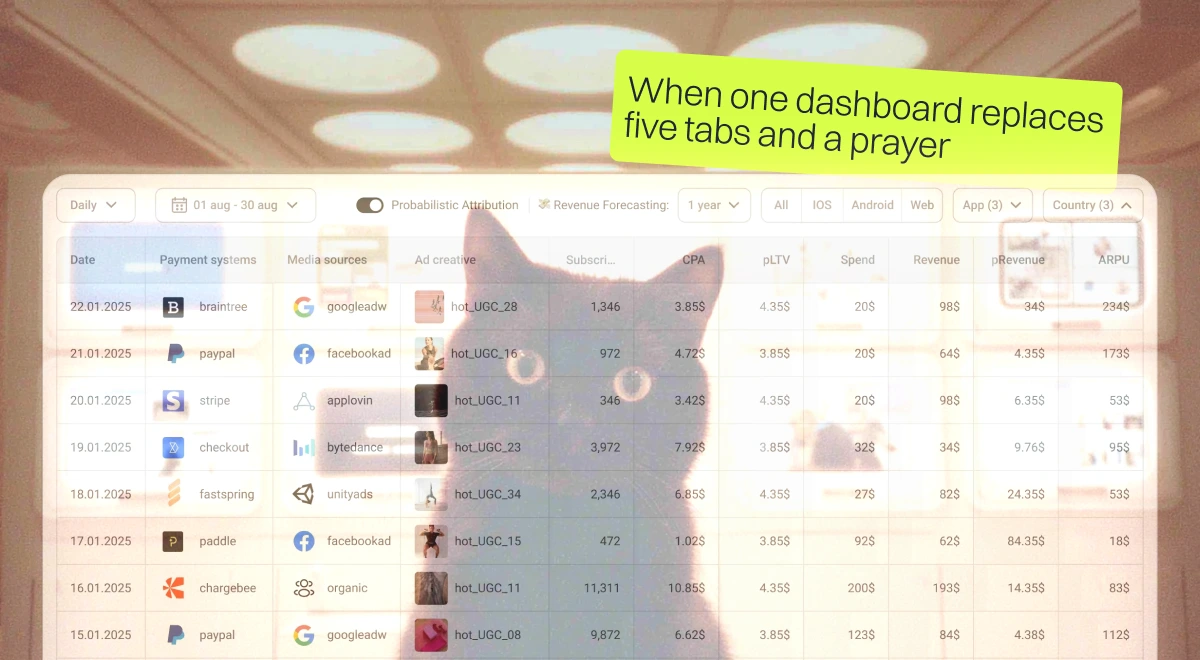
Why Planner 5D chose Campaignswell
When the team evaluated how their analytics and marketing stack supported growth, they saw a clear direction: the next stage required a partner built for speed and depth, not another layer of dashboards to maintain. That’s what led them to Campaignswell.
A platform that felt familiar in the right way
During the evaluation phase, Head of Data at Planner 5D immediately recognized the logic behind the product. It echoed what his own data team would have built internally if they had the time.
As Denis put it during our conversation: “We would’ve built something similar ourselves, just slower. Campaignswell already had the expertise and the focus to run this system better than we could in-house. It felt like an extension of our team.”
A true fit for a hybrid funnel (web + app)
Planner 5D needed unified logic that treated their user journey as one ecosystem across platforms and payment systems. Campaignswell aligned with this need from the start by giving them a full-funnel view that mirrored how their business actually works.
Predictive insight that covered all key channels
Early quality signals were a priority for the UA team. They wanted prediction across Google, Meta, Apple, and the web instead of isolated models for individual platforms.
Denis emphasized this early on: “Our predictions had to reflect the full acquisition picture, not just one channel.”
Support that strengthened a small data team
With only three people covering the full data layer, any added operational weight was a deal-breaker. Campaignswell fit the role of a lightweight but powerful extension of their analytics function, one that didn't require maintenance cycles or additional headcount.

What changed after implementing Campaignswell
Once Campaignswell was fully integrated, the biggest shift came from how quickly the team could evaluate performance. Decisions that used to take days turned into minutes, giving UA a clear advantage in early-stage testing and changing the rhythm of how experiments were run.
Consistent predictions that earned the team’s confidence
Since the Planner 5D team is strong in data, they didn’t rely on predictions blindly. They checked Campaignswell’s forecasts alongside their own metrics and early cohort signals, making sure the patterns aligned. When they had questions or wanted to double-check a trend, they shared it with us, and we worked through it together. This created a healthy feedback loop, and it’s something we genuinely appreciate.
As more campaigns ran through the system, the team saw the predictions hold steady across different tests and geos. That consistency made the UA and Data teams increasingly comfortable using the predictive layer as a core part of their decision-making.
As Denis said: “We regularly compare the predictions with our internal metrics, and the alignment gives us confidence. The quick feedback cycle with the CW team helps us stay on top of any questions, so the predictive layer naturally became part of our decision process.”
Earlier clarity on traffic quality
Predictive pLTV and pROAS allowed the team to understand campaign direction long before revenue appeared. Early signals became the foundation for pacing, scaling, and cutting spend at the right moment.
As Denis, Head of Data, shared: “Earlier signals change how we pace campaigns. They give us confidence to move faster.”
A smarter allocation of budgets
With performance differences finally visible across channels, they were able to shift spend toward the sources that showed real potential and trim the wasted portion almost in half. Traffic volume remained stable, while overall efficiency improved.
As Denis, Head of Data, noted: “We reduced inefficient spend almost twofold without losing traffic. We simply rebalanced things correctly.”
Clearer channel opportunities
Channels that once looked unpredictable, like Facebook, became easier to manage because the team could finally see how early user behavior translated into long-term value. This opened space for new tests, including mobile campaigns on Google and broader geo exploration.
A lighter load on analytics and faster collaboration
Granular insights (down to keywords, creatives, and ad groups) now come from Campaignswell rather than manual checks. This cleared significant time for both UA and Data, making collaboration simpler and weekly planning more focused.
More experiments with faster feedback
One of the biggest shifts came in how easy it became to run and evaluate experiments. The team can now launch a campaign, watch early cohort behavior, and understand its trajectory within days rather than waiting for delayed subscription revenue.
As Svetlana explained, this changed the entire pace of testing: “We can launch a campaign, track cohorts, and understand performance quickly through predictions. If it’s clear the model won’t carry it, we know within a week, long before any revenue appears.”
Previously, the earliest revenue signals arrived only after the 7-day trial period ended. Until then, the team relied on manual estimations of trial value as a proxy prediction, a process that created unavoidable delays. With Campaignswell, the cycle tightened dramatically, and experiments started moving at the speed the team always wanted.
A noticeable reduction in operational load on the data team
Many recurring tasks, like breakdowns, comparisons, quick checks, investigating discrepancies, moved into Campaignswell. This freed up hours each week for the analytics team to focus on product metrics and strategic work.
Denis explained it: “Campaignswell saved us time, and we invested that time into growth.”
Better alignment across UA, data, and product
А single view of the funnel, combined with early predictions, reduced the time teams spent reconciling numbers. Conversations became more strategic because everyone looked at the same data and understood the same signals.
Planner 5D now uses Campaignswell daily for:
- evaluating traffic quality in the first days of a test,
- understanding cohort behavior across platforms,
- planning budgets for upcoming quarters,
- exploring new channels with early predictive signals,
- preparing hypotheses for A/B tests,
- quick sanity checks before scaling spend.
A stronger foundation for controlled scaling
The workflow simply became smoother. Experiments ran quicker, early clues were easier to read, and the team felt more sure about the choices they made.
As Denis summarized: “With this setup, we can scale in a controlled way. That’s exactly what we needed.”

Results & impact
The changes in workflow quickly turned into measurable forward movement. Instead of fighting for clarity or waiting for revenue to settle, the team began using their time, budgets, and tests in a far more intentional way.
A faster path from idea to validation
The team no longer worries about the “cost” of running another test. Concepts move from draft to launch to insight far quicker, which expanded the range of ideas they were able to explore. They now validate new creatives, geos, and audiences in a steady flow, not in limited batches.
More confident budget decisions
Early predictive insights gave the team a clearer view of what deserved more spend. This allowed them to support their strong growth curve while keeping marketing efficient. Budget conversations inside the company shifted from cautious to structured and informed.
Clear visibility into which channels can scale
With one unified view and early performance signals, Planner 5D began to map out where future growth could come from, not only from Google, but across Meta, Apple, and web as well. This moved expansion planning from speculation to a more data-backed conversation.
A noticeable improvement in team bandwidth
UA and Data both gained more time for higher-value work. UA could focus on strategy instead of report assembly. Data could focus on product metrics and deeper analyses instead of constant micro-requests.
Better alignment on where growth is coming from
Both teams now share one story of the funnel. There’s no need to compare dashboards or argue about why numbers differ. This created smoother weekly planning: everyone sees the same signals and interprets them the same way.
A growth motion that feels stable and scalable
Planner 5D now works with a clearer understanding of when to accelerate, where to expand, and how their tests influence longer-term value. They describe the new workflow as calmer, clearer, and more predictable.

A few words about Campaignswell
Campaignswell is a SaaS BI platform built for growth teams that want to scale faster without expanding their analytics headcount.
It brings every acquisition channel into one structured view, predicts long-term value early enough to guide decisions, and helps UA, Data, and Product work from the same source of truth.
The platform is designed for hybrid funnels and subscription products where value unfolds over time, not in a single payment event. Campaignswell shows early signals that actually matter: which channels have room to grow, which creatives bring high-quality users, and which geos behave stronger than expected. All of this happens long before revenue fully settles.
Teams use Campaignswell to run more experiments, reduce wasted spend, plan budgets with confidence, and scale with a level of predictability that traditional BI tools rarely offer.
And it works without heavy engineering involvement or long implementations; integration takes just a few days, and teams don’t need a large analytics department to keep it running. The system fits cleanly into an existing stack.
If your ambitions are growing faster than your current BI setup or if your team already spends too much time stitching data instead of acting on it, Campaignswell can help you change that.
Book a demo, and we’ll walk you through what Campaignswell can unlock for your team.

Co-founder & CEO at Campaignswell
Book a demo


Co-founder at Campaignswell
Use the session to ask your hardest questions about scaling, LTV, or attribution, and see how full-funnel predictive analytics gives you clear, actionable answers.





.webp)