The 10× Growth Mindset: field notes from growth expert who scaled 100+ apps

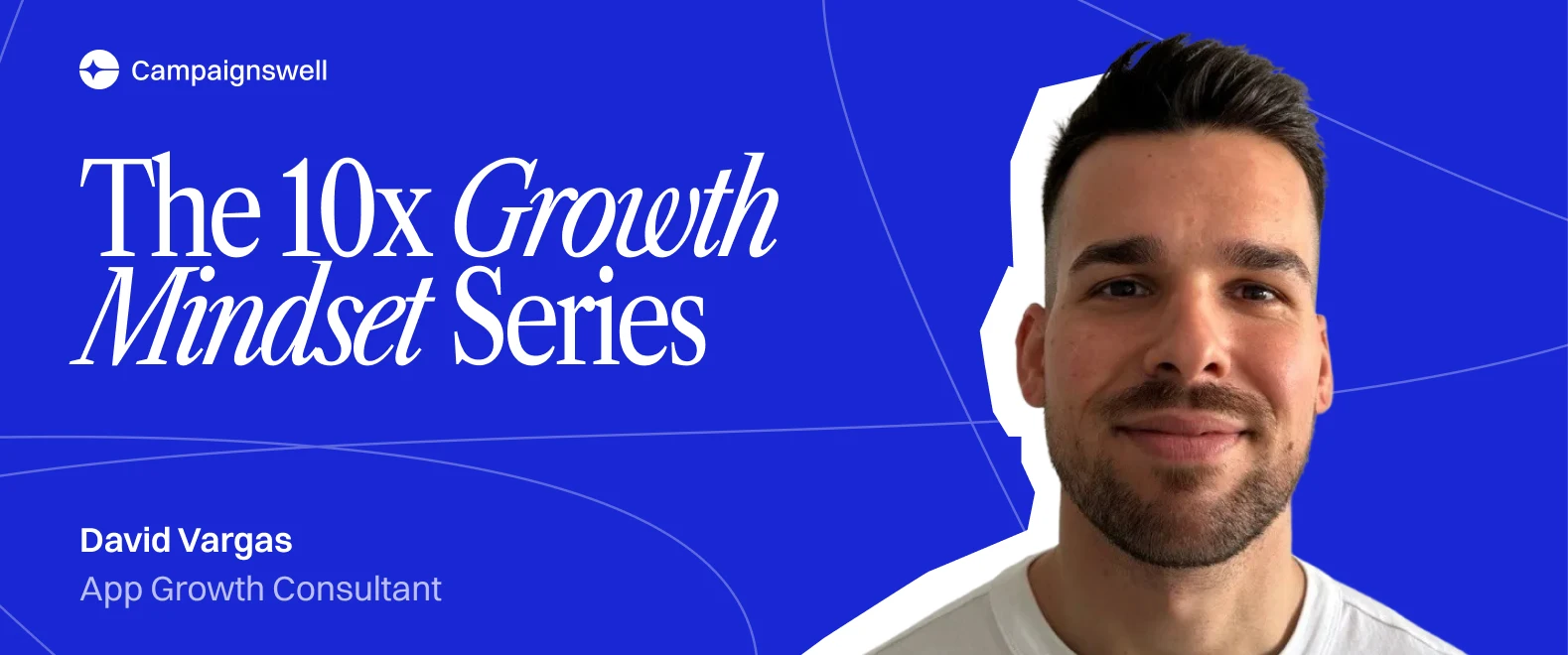
Welcome to 10× Growth Mindset, created together with seasoned app growth operators who have lived through every kind of funnel and fire drill. We look at why some apps climb past their limits while others stay stuck, and how the right mental models turn chaos into momentum.
Meet our next co-conspirator, David Vargas, App growth consultant. Eight years in mobile growth gave David one of the widest data sets a consultant can get. Through agency work and independent projects, he touched 100+ apps from lean 5K tests to portfolios running 5M each month, with peak days at 150K.
We discuss the patterns he sees in teams that scale fast, the ones that get stuck, the data foundations every app needs, and the analytical habits that give him confidence to increase spend. David breaks down common misconceptions about UA, why good marketing often beats a “better” product, and how he balances paid vs. organic fundamentals.

How fast teams and smarter data beat raw ambition
Campaignswell: Do you think every founder needs a 10× ambition to succeed, or is a different mindset more important?
David: I don’t think ambition is the key trait that decides whether someone succeeds. What actually matters is building the right team, because you need people who cover every part of the growth machine. And then you need the ability to grow while keeping efficiency. Anyone can grow if they just throw money into ads The hard part is scaling and staying efficient at the same time. That takes knowledge, coordination, and a team that understands each side of the business. So for me, it’s less about ambition and more about the structure and expertise you put around you.
Campaignswell: Across all the apps you’ve worked with, what patterns separate teams that scale from teams that get stuck?
David: Well, first, the ones that are fast when it’s time to execute. When something needs to be done, they don’t wait forever, they just go and test things. It’s better to receive a learning of a failed test than missing a potential opportunity to grow efficiently.
Second, they rely a lot on data in order to make decisions. I think the best teams combine both: they have speed when they execute the actions, and they also have speed when they analyze the data and use it to move the needle. In today’s world, data is not accurate (mostly with iOS) and those who are capable of building an accurate picture about the real impact of the campaigns are the ones that will succeed.
What misconceptions kill scale before it starts
Campaignswell: We talk to a lot of app founders, and one theme comes up again and again: the desire to scale is there, but the fear of doing it without solid, trustworthy data holds them back. Many feel they’d be pushing budgets while half-blind. What gives you the confidence to scale spend, and what do you lean on when the stakes rise?
David: Well, confidence is something you build when you are good at cross-checking and comparing all the data points. It is not something that you will get by blindly trusting your MMP data. You have many different data points and none of them are showing the same numbers so obviously you can’t convince yourself that one of them is showing the absolute truth.
When you are capable of creating different scenarios with these different data points and seeing what is the real trend, what is the real picture of your campaigns, then you can make correct decisions with no fear or with very low risk. The data is tricky, it never matches. But that’s when a good marketer comes in and says, ‘Okay, we have all these data points, all of them are different. We don’t know what is 100% truth. But we know the trend is going in this direction.’ And then we apply the decision that fits that trend.
it’s not about fixed scenarios anymore. It’s about creating ranges and dynamic scenarios and adapt your campaigns to such dynamics. Then, every time that you make a decision, you have to re-check and make sure that the dynamic you analyzed was going in the correct decision so your campaigns are performing as you expected
Campaignswell: Based on your work with different companies, what are the common failure points that appear when growth accelerates?
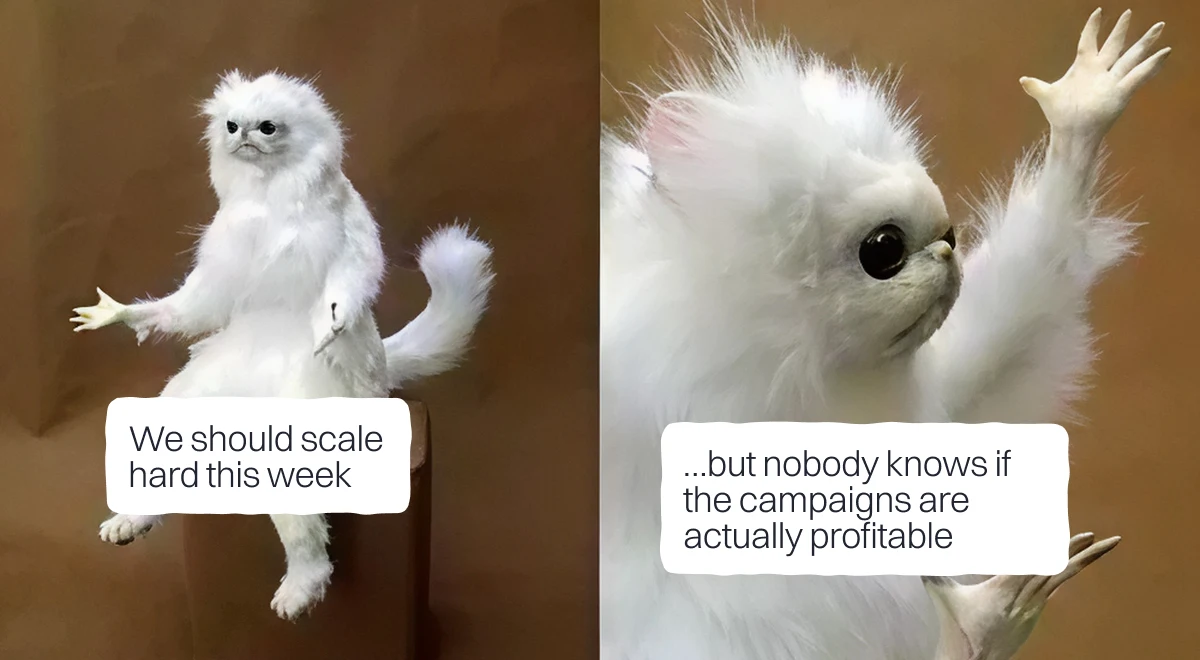
David: From what I’ve seen, there are two main blockers. First, many teams simply don’t know what’s happening inside their campaigns. They can’t tell if they’re profitable or not, and they don’t know how to interpret the data they’re looking at.
Second, some companies operate with very tight margins. When the room for error is small, they're afraid to push spend because they worry any extra investment could break the profitability of the whole business.
These two situations show up all the time, but the most common one is the first: people have no clue what’s going on in their campaigns or how to read the numbers properly, so they end pausing or going really slow because they don’t have certainty.
Campaignswell: And what are the most dangerous misconceptions you’ve seen around user acquisition and scaling?
David: One big misconception is trusting the numbers you see inside the ad networks — Facebook Ads, Google Ads, Apple Search Ads, whatever. Those numbers are not 100 percent accurate.
If you fully rely on them to make decisions, you’ll likely be wrong. People think scaling is just about checking those dashboards, but it’s not that simple. You have to go beyond that surface-level view. You need to build a more complex scenario because you’re working with multiple data points, and none of them match perfectly.
SKAN, the ad networks, the blended data and your own modeling. These are the 4 scenarios that I use to increase the probabilities of being right about my campaign decisions.
What teams get wrong about channel selection
Campaignswell: Let’s switch to the balance between product and marketing. There’s a popular opinion that teams should work on retention and product improvements first, and only then invest into user acquisition. What’s your take?
David: I’m totally against that.
Good marketing can cover a bad product. Bad marketing can never make a good product work. Never. So marketing, at least nowadays in the app industry, sits at the top of the priority list. If you’re not good at distributing your app, it doesn’t matter how good the product is, you won’t get anywhere.
On the other side, you can have a product that’s not top-tier, not amazing, but if you're strong in marketing, if you know how to distribute it, you can still get decent numbers.
Of course, you need balance. You need to work on the product and make it usable. But in my experience, I’ve seen a lot of bad products making money, and a lot of very good products failing because the marketing was bad.
And I don’t think this opinion is that unpopular anymore. There are plenty of low-quality apps making money just because they’re great with TikTok creatives or Meta creatives. Distribution is becoming more and more important and now with AI it’s becoming more accessible for everyone. You need something decent, yes, but you don’t need the best product ever to win.
Campaignswell: Early-stage teams often struggle with the same question: how to find the first acquisition channel that actually works. What’s your recommendation? What’s your strategy?
David: For Android, the answer is, in most of the cases, Google Ads. You advertise directly on the Play Store, the traffic is high quality, and it’s very cheap although there are 2 big disadvantages on this channel:
- You lose the control over the delivery since these campaigns are completely automatic
- If you’re a big brand, you will likely cannibalize your brand installs unless you ask to a Google rep to negate these keywords in both, the account and the campaign level. an.For iOS, I start with Meta. The reason is the ability to steer the algorithm toward different audience segments. In Meta you can reach younger users, middle-aged users, and older ones as well because you have Instagram, Facebook, and Threads. That gives you a very wide scope of user personas.
On TikTok you don’t have that range. It’s mostly millennials and Gen Z. So in my opinion, when you’re starting, Meta is the better option for iOS because almost any product can find its audience there.
Campaignswell: Paid and organic acquisition, how do you think about the strategic balance between them?
David: ASO plays a huge role at the very beginning. When you’re starting out, your product page has to be as optimized as possible. You shouldn’t launch paid campaigns until that page is ready, because every paid user will land there (or a CPP that you build for that). So before spending even a single dollar, ASO needs to be solid. That’s mandatory at the early stage.
Once that foundation is in place, organic becomes more of a complement than a core driver. Right now your organic performance depends heavily on paid volume. The fastest and most effective way to increase your keyword rankings is by increasing your daily installs and paid UA is the fastest way to boost that. Once you have a solid UA strategy in place, you still have to work in ASO (CPPs, in-app events, kw optimization, A/B test, etc), but in this stage, I see ASO as a complement to growth, never the foundation.
So the sequence is clear: ASO is crucial at the start, and you must prepare the page properly. After you begin scaling, organic moves into a complementary role. Not unimportant, but definitely not as impactful as paid.
How to scale spend without spreading too thin
Campaignswell: Let’s talk about budget strategy. How should a project think about increasing ad spend, and what does it depend on?
David: In big-picture terms, when you start, the first decision is whether you’re going to run on both platforms or focus on one — iOS or Android. After that, at the very beginning, it’s extremely important to focus on one channel only and optimize it before touching anything else.
There are two reasons:
- It’s easier to measure.
- Early-stage teams almost never have enough budget to fully squeeze a channel, to milk it properly.
My usual recommendation is: Google Ads for Android, Meta Ads for iOS. Stick to one of them until you reach roughly 0 to 50K in monthly recurring revenue.
Once you start growing, then you can bring in other channels. For Android, you can add Meta. For iOS, you can bring in TikTok or Apple Search Ads. But everything depends on performance.
My mindset is always the same: whenever I start a channel, I try to squeeze it to the maximum. When I hit the ceiling, that’s the moment to consider another channel, but never before. And of course, every campaign across every channel must be achieving the target that was set for them.
Campaignswell: We touched on iOS vs. Android earlier, but anything you’d add on choosing the first platform for user acquisition?
David: The platform choice usually depends on technical limitations whether you have the resources to build both apps or only one.
But if I have to choose, I normally recommend iOS first. iOS users generally have higher quality: they pay more, they show higher LTVs, higher retention, and they stick with apps longer. So I pick iOS even though tracking limitations exist there. I don’t worry much about those limitations because I know how to work with different data scenarios.
So yes, iOS is my priority, and on iOS I usually start with Meta Ads.

What a growth-ready team really looks like
Campaignswell: Let’s talk about growth setup. You’ve mentioned that the team is crucial for scaling. What kind of setup do you recommend, both the team structure and the way the marketing engine should be organized?
David: For people, you need three roles. First, someone responsible for the product — a product manager or a person who owns the product decisions. Second, a technical person who can implement whatever the product manager or marketer needs. Third, someone capable of running paid campaigns efficiently, whether on ad networks or with influencers. Those three are very important.
In terms of tools, you don’t need much at the beginning. A data tool like Amplitude is enough. You can also rely on free solutions like Firebase for analytics. And then you have SDKs from the ad channels themselves — Facebook, TikTok, etc.
If you’re more advanced, you can use platforms like Appstack or MMPs. But to start, you don’t need any of that. The free tools already get you going.
Campaignswell: When teams aim to boost growth, where does their thinking typically go off track?
David: One very common mistake is diversifying too early. Teams jump into multiple channels while I’m pretty sure they still have room to grow on the channels they already use. They give up too early, assume a new channel will magically perform better, and move on too fast.
Another mistake is not playing well with data. Some companies over-attribute their campaigns, think performance is better than it actually is, and then make very aggressive budget decisions. Working correctly with data is hard, and I see many wrong decisions simply because people are not reading the numbers properly.
Campaignswell: When it comes to metrics, which ones do you consider essential, which ones feel like vanity, and what would you call your North Star metric?
David: Well, it depends a lot on the product. Gaming and non-gaming apps have totally different metrics.
For gaming, you normally look at ROAS and retention on different time frames. Then, if the game only monetizes through ads you look at ARPU, ARPDAU and other metrics related to that but if the game relies on IAPs, you go with ARPPU, CACs,etc.
For non-gaming, you look at CAC and subscriber retention mostly as these will determine your LTV and your potential payback period and hence, your profitability. Beyond that, of course, there are sub-metrics, but those are the main ones.
Campaignswell: And the final question: if you could leave founders with one operating principle, what would it be?
David: Don’t spend too much time adding features. Build one core feature that can be marketed fast and efficiently. That’s the principle you need today.
If your product delivers one strong, easy-to-market value, you already have a good base. Focus on creating that connection between marketing and product. Once you start distributing with paid ads, focus on squeezing each channel to the maximum.
But success becomes very hard when the product lacks a clear core feature that’s easy to communicate to the right user.

A quick note from Campaignswell
Campaignswell is a SaaS BI platform that helps growth teams go beyond what MMPs and ad network dashboards show on their own. We connect SKAN, MMPs, network numbers and your internal data into one view, so it’s easier to understand how performance actually looks across channels.
Inside the platform, you can look at results on a cohort level, see which cohorts really bring in revenue and where payback happens. On top of this historical view, Campaignswell runs cohort-based predictive models: we forecast LTV, payback and pROAS by campaign, geo, and even creative. These forecasts start early in the cohort’s life and update every day as new behavior comes in, so you see where returns are heading instead of waiting weeks for final numbers.
That mix of real cohorts and live predictions makes it much simpler to scale what works and switch off what doesn’t, without relying on a single noisy data source. Campaignswell is there for the moments when the growth questions are obvious “Can we push this?”, “Should we cut that?” but the answer in the data isn’t.
If you ever want to see how this works on your own data, you can book a quick demo and we’ll walk you through the setup and show how Campaignswell reads your growth engine in real time.

Co-founder & CEO at Campaignswell
Book a demo

Co-founder at Campaignswell
Use the session to ask your hardest questions about scaling, LTV, or attribution, and see how full-funnel predictive analytics gives you clear, actionable answers.
10x Growth Mindset from a BetterMe and Replika growth leader: The uncomfortable truths behind scaling subscription apps
10× Growth Mindset: The real reason teams stop at $10K–$100K in spend
10x Growth Mindset from a Meta insider: What matters more than algorithm tactics for subscription apps on Meta
10× Growth Mindset: How app founders engineer a system for repeatable wins and forecastable outcomes