10x Growth Mindset from a Meta insider: What matters more than algorithm tactics for subscription apps on Meta

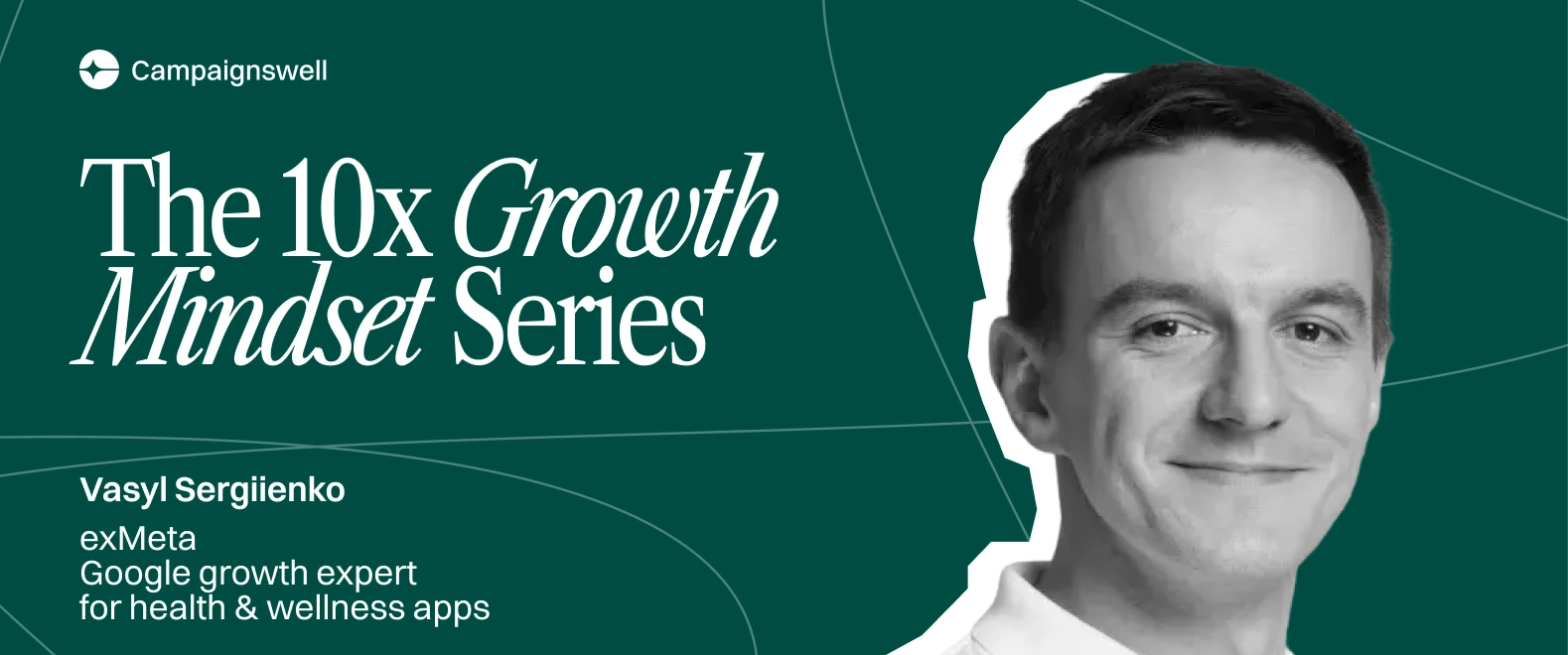
Welcome back to 10× Growth Mindset series.
In this project, we speak with experienced growth operators to understand how subscription growth works in practice, and what allows teams to move beyond local growth ceilings. Growth tends to move faster once teams understand how the whole system fits together, rather than trying to fix things one tactic at a time.
And today’s guest Vasyl Sergiienko brings exactly that kind of view.
For more than five years, he worked at Meta, partnering with leading health & wellness and consumer apps across Europe. His focus was helping teams turn paid acquisition into something they could rely on — from web-to-app strategy and creative structure to measurement and decision-making at scale.
He has recently joined Google as an Industry Manager, where he continues working closely with app businesses on growth models that hold up over time.
In this conversation, we talk about how to keep both algorithms and real people happy with your ads and what it actually takes to keep growing in 2026.
If your goal for 2026 is to seriously boost your app’s growth, this interview will help you get the right setup in your head before you start pushing harder.
Campaignswell: Looking back from 2026, what are the top 2–3 changes in Meta that most impacted health & wellness apps?
Vasyl: The biggest shift is how content is produced. Health & Fitness has fully turned into a content-driven business. Over the last six months, content creation itself changed dramatically because of generative AI. Teams can now generate creatives fast and at massive scale. Users respond to it well.
Advertisers like it for obvious reasons. And very quickly, it became clear: the teams that can produce more creatives, faster, are the ones who win.
But that immediately triggered a second-order effect. Today, ad libraries are completely open. Everyone sees everyone. You don’t just compete with a few players in your niche anymore, you’re competing in a fully transparent environment where every idea is visible within days. When copying becomes easy, speed alone is no longer enough.
That’s where structured analysis becomes critical. A year or two ago, teams could still scroll through ad libraries manually, rely on intuition, and say “this looks like it works.” That approach simply broke. The volume of creatives is too big. You physically can’t process it by hand anymore. So teams moved toward algorithms, data-heavy analysis, clustering, tagging — real systems for understanding what actually drives performance, not just what looks similar.
The creative side is becoming even more central. It serves as the main driving force behind team development and product growth, the core engine of progress. At the same time, creative teams themselves changed. Creativity became more technical. Today, every serious team has at least one person whose job is to constantly track what’s happening in generative AI and figure out how to apply it to production. Creative producers are no longer just writing briefs; they’re writing prompts, designing systems, thinking in iterations. Editing by hand is already fading, and in many cases, AI assembles creatives almost end-to-end.
The pace of this change is extremely fast. For larger teams, especially those with real technical and server resources, this creates an additional competitive advantage.
When new algorithms and new models appear almost every month, bigger teams are simply able to implement these changes faster than smaller ones. And over time, that speed turns existing resources into an even stronger competitive edge.
Campaignswell: You said analysis is critical right now. How should teams actually approach analysis, and which tools work best today?
Vasyl: Honestly, there’s no simple answer here. From what I see, most market tools are lagging behind reality. They solve very basic problems, but they don’t keep up with how fast creative production and data volume are growing.
The most effective setups right now are usually internal, custom-built solutions. Teams build their own BI-like tools tailored exactly to how they work. And they use them in two main directions.
The first one is analyzing their own creatives. Today, teams produce a huge volume of ads, so structure becomes essential. You have to tag creatives properly, define attributes clearly, and keep everything organized from the start. Otherwise, later analysis just doesn’t work. When creatives are tagged correctly, you can actually identify what specific feature caused one ad to outperform another. That could be a hook, a visual pattern, a narrative angle, a persona, something concrete. Once you find that signal, you can iterate on it and generate more creatives around the same idea, increasing your chances of success.
The second direction is competitor analysis. Here the task is different. You take the entire ad landscape you see on the market and try to cluster it properly. You look at which personas are being targeted, which angles dominate, and where there are gaps. Very often you realize that you’re missing certain personas or motivations,maybe two or three that you’re not covering at all. That insight alone can open up new creative directions.
To do this properly, teams rely on things like Meta Ad Library and the Ad Library API. These allow you to pull large volumes of ads and build your own indexes. You can track what’s growing, what’s fading, and what patterns repeat over time. As a proxy signal, teams also look at tools like App Annie to see which apps are growing fast. If an app shows strong growth, that’s a reason to check its ad library and see what new creatives it recently launched.
A big reason why external tools often feel weak is that many of them stopped evolving a year or two ago. There are plenty of tools that help you save ads from libraries, organize them, maybe extract some basic data. They exist, and people use them. But deeper analysis, especially video analysis at scale, is expensive and technically complex. Not many businesses are willing to pay for that level of depth.
The reality is that most of the market only needs basic storage and light analysis. Advanced analysis exists, but it’s usually done in-house by teams with strong technical and creative resources. That’s why you see top advertisers building their own systems instead of relying on generic tools. Their needs are simply broader and more complex than what off-the-shelf products offer.
Campaignswell: Meta is clustering users more deeply by behavior and mindset. What does this mean for wellness products, where motivation and emotional context are critical?
Vasyl: The first thing to understand is that platform algorithms will keep changing. They have no choice. The volume of creatives uploaded by advertisers is growing extremely fast, and platforms have to adapt just to be able to process all of that content. So yes, algorithms evolve, and they will continue to do so.
At the same time, there’s a very important thing that often gets lost in these discussions.
Performance marketing is still marketing. Before anything else, it’s about people. The primary question hasn’t changed for decades: why should a person like this ad, and why should they want to buy what you’re offering?
That’s why, especially for wellness products, marketing fundamentals stay stable no matter how algorithms shift. Human motivations don’t reset every time Meta updates its model. People still buy based on desires, fears, pain points, and aspirations. Those things are old, proven, and well described long before performance marketing even existed. I personally like classic American marketing books from the 80s and 90s because they explain buyer psychology very clearly.
The challenge today is that copying has become incredibly easy. You can open ad libraries, see what competitors are running, and replicate it in minutes. Because of that, competition exploded. When everyone copies, the advantage disappears very quickly. This pushes teams toward a much harder task: generating something original from a marketing perspective. Something that actually resonates with users, instead of being just another variation of the same idea.
This is especially critical in web-to-app. Web-to-app is a way of selling an app before a person really uses it. You ask them to pay first, without full experience of the product. To make that work, you need to hit strong emotional motivations. You need to create enough internal justification for the user to feel comfortable paying upfront.
What often happens is that performance marketers dive very deep into numbers, charts, and dashboards. They analyze everything, but miss the most fundamental question: why should this person buy? Not because your CTR is high or your chart looks good, those things are secondary. The real question is who your users are, how they think, what drives them, and what problem they believe you’re solving for them.
If a team understands this clearly from a marketing perspective, who their users are, and why they buy, then changes in algorithms become much less scary. The team stops chasing platform behavior and starts building communication that works regardless of how Meta reshuffles users internally.
Campaignswell: What are the biggest mistakes you see in health & wellness teams that are still “playing by 2023 rules,” but no longer win in 2026?
Vasyl: One of the biggest mistakes is that many teams still treat technical factors as the main growth lever. Especially on platforms like Meta, and even more compared to Google, technical optimization plays a smaller role than it used to. The center of gravity has clearly shifted toward creative.
In practice, this means that the role of the media buyer is becoming less dominant, while the role of the creative producer keeps growing. Very soon, and in many teams already today, you’ll see a structure where one media buyer works with five creative producers, not the other way around, like it used to be.
Creative production has become more complex and more resource-intensive. That’s exactly where most innovation is happening right now, and that’s where most growth opportunities are hidden. But many teams still don’t fully realize this shift.
A common mistake is simply not understanding where growth actually comes from. This happens a lot with founders or business leaders who never ran ads themselves. They often look for growth answers in the media buying function, because that’s where the spend is. But real growth usually comes from the creative side, from the people who build the messages, angles, and narratives behind those ads.
Another serious issue is how teams are structured internally. Media buying and creative often live in separate silos, with poor communication between them. When results are bad, the explanation is usually simple: “We were given bad creatives.” But if results matter to you, you can’t stop there. You have to care about the quality of creatives, push for collaboration, and work together instead of passing responsibility around.
There’s still a very common pattern where a business leader goes to the media buyer, essentially a cost center, and asks why performance is weak. The answers you get in that setup rarely address the real problem. Teams that have already gone through this pain, especially founders who personally ran ads before, understand it very clearly: when creatives are strong, performance follows.
So the core mistake is still the same. Teams underestimate creative as a system and overestimate technical optimization. Until that balance shifts, they keep playing by old rules and those rules no longer produce growth.
Campaignswell: Which types of storytelling in health & fitness have stopped working?
Vasyl: We can’t really say that some types of storytelling work better and others work worse in general. It doesn’t work like that.
What actually changed is not the type of storytelling, but the speed. Two years ago, a business could come up with a strong concept and run on it for a year. Today, that’s very hard to do.
There are exceptions. For example, I follow a few businesses that use celebrities in their ads. Celebrity-based advertising can’t really be copied. It’s protected by intellectual property, and competitors simply can’t replicate it. Because of that, those ads can run for years and keep working.
But in our region, nobody has really gone into that direction or built similar projects. As a result, our entire business model is built around operational efficiency: faster, more efficient, more volume. And at that speed, concepts don’t live long anymore. They burn out much faster.
So the main shift is this: the speed of burnout has increased significantly. Concepts work for shorter periods of time. On top of that, AI-driven formats appeared. People like them, nobody fully understands why, but they work, and businesses have to deal with that reality.
Campaignswell: What scales better on Meta right now: expertise, transformation, social proof, or mirroring the user’s pain?
Vasyl: There’s no single answer here. Different applications respond differently.
What’s important is not choosing one angle and sticking to it. What’s important is how the business structures its advertising internally. Teams need to clearly classify their creatives: this format is “expertise,” this one is “transformation,” this one is “social proof,” this one is “pain mirroring.” Each category has to be described and understood.
From there, the business builds a marketing mix — a portfolio of different types of creatives. At certain periods, one type may work better. At other times, another one performs better.
The key point is not to get stuck on a single approach. A healthy portfolio matters. Budgets should be spread across different formats, everything should be tested, and spend should be distributed in a balanced way.
Focusing on one angle only is almost always a bad idea. Diversification is consistently the better strategy.
Campaignswell: If you had to put it simply: what separates creatives that generate stable LTV from creatives with high CTR but weak business impact?
Vasyl: To answer this, you first need to understand how CTR and LTV relate to each other. Very often, creatives with high CTR are clickbait. And clickbait creatives usually have low LTV.
That’s why teams need a healthy balance: between clickbait and non-clickbait creatives, between static formats and video. Video, traditionally, has a much higher LTV.
A business has to be sensitive to this and able to see it clearly. It needs to understand which video formats produce higher LTV and communicate that internally. Many teams don’t see this and end up prioritizing creatives with high CTR, which leads to losing LTV later.
Another important point is that different videos work for different audiences. Different audiences have different LTV. Older users almost always have higher LTV.
Because of that, teams need to clearly define their strategic goal: who they want to work with — younger users or older ones. Based on that choice, budgets should be allocated accordingly, and enough creatives should be produced for each audience segment.
The key skill here is sensitivity. Teams need the ability to understand which type of video works better for which audience and what the LTV difference is. Strategy should be built from that understanding.
CTR on its own is a good metric. But in the end, everyone works for LTV. That’s the metric that needs to be analyzed first.

Campaignswell: Do you use predictions in your work? And do you recommend using them, specifically, LTV prediction?
Vasyl: LTV prediction is something everyone uses. This isn’t a new trend or a fashionable technique, it has always been the foundation of this business.
The core formula hasn’t changed for years: your user acquisition cost has to be lower than your predicted LTV. That’s it. This is the basic condition for success. Everyone who works seriously in this space relies on predicted LTV in one form or another.
What really matters here is when you make that prediction. The main advantage of this business model is that LTV can be predicted with a fairly high level of accuracy at the moment of purchase. Exactly at the moment of purchase.
If you try to predict LTV at the start of a free trial, the accuracy drops significantly. It’s much harder to forecast outcomes at that stage. But when the prediction is made at the purchase moment, the precision is much higher. Even at a cohort level, you can predict LTV with a high degree of confidence.
And once you have that, you use it every day. You can clearly see whether today’s traffic is profitable or unprofitable, and adjust budgets immediately. You don’t have to wait until the trial ends to understand what’s happening. Decisions are made right at the purchase moment.
This is extremely effective. It’s one of the fundamental advantages of the web-to-app model.
Campaignswell: Financing through funds: is this a viable growth tool for app businesses?
Vasyl: Yes, this is a solid and practical tool, especially when a business wants to scale without giving up equity.
This type of financing became particularly popular ahead of high-spend periods like Q5. Businesses looked for ways to temporarily increase their financial capacity, and loans from funds turned out to be a good solution.
The key advantage is structure. These loans don’t require giving up a share of the company. The interest rate is relatively low, around 8% annually, and in some cases even lower if the capital is deployed efficiently. Repayment is tied to future cohorts, which means the fund shares part of the risk with the business instead of pushing all the pressure upfront.
Because of that, this format works well for stable, growing companies. Funds usually have requirements: the company can’t be very small, and there needs to be enough historical data to forecast performance and risks properly. But when those conditions are met, this is a proven and fairly safe model. There are public cases that show it works.
I absolutely recommend this approach for app businesses. Especially in situations where the company doesn’t want to dilute ownership. This kind of financing gives teams more freedom in growth decisions. The fund doesn’t participate in operational decisions and doesn’t influence strategy. The core requirement is simple: the business stays profitable and grows if it chooses to grow.

Campaignswell: Which health & wellness subcategories look the most promising right now from a Meta UA perspective?
Vasyl: When we talk about health & wellness, it’s important to remember how broad this space actually is. Today we mostly discussed digital products across both large and small niches. But wellness as a whole is much bigger than that.
There are wearables, supplements, AI-related products, medical services, and many other categories. Right now, there’s clear interest in supplements, although anything connected to physical products is a much more complex type of business.
At the same time, we see physical products performing extremely well when they’re built as strong ecosystems with powerful brands. There are already examples of physical wellness products with massive capitalization and very strong brand positioning. Nothing looks as convincing as a solid story combined with a well-built ecosystem.
Another area that hasn’t really been discussed much in our market is GLP-1 — weight loss pills and the ecosystem built around them. This trend is still barely present in our region, and very few products here are even looking in that direction. But in the US market, it’s already a huge trend with strong demand and significant money flowing into it. It’s definitely a direction worth paying attention to.
Overall, the market is gradually moving toward more hybrid models. Hybrid in terms of monetization, for example, wearables combined with subscriptions. And a hybrid in terms of promotion means not relying on a single channel, but combining paid ads with influencer marketing or organic growth.
We already see strong examples of this. Some apps actively use influencer marketing and, through that, present themselves in a way that feels different from what people are used to seeing in classic paid advertising. That’s why, looking ahead, more complex and hybrid business models seem especially promising.
Campaignswell: Which products will be harder to scale through Meta, regardless of budget?
Vasyl: Scaling is becoming more difficult overall. The app market is still growing, but at the same time it’s becoming more complex and more dynamic.
Smaller teams are at a disadvantage here. They usually have fewer resources, which makes it harder to implement things like AI quickly. They run fewer tests and rely more heavily on copying what already exists in the market. That makes it harder to stay competitive.
On top of that, regulation pressure keeps increasing. External regulators add more constraints, and this raises the cost of entering the market.
There’s also user fatigue. People are getting tired of standard recipes. They understand that claims like “lose weight with zero effort” are just advertising slogans without real substance behind them. When someone has seen the same message fifty times and already bought similar products several times, they may simply stop reacting to it.
As a result, businesses are forced to invent something new, something different. And that increases complexity even further. All of this makes scaling harder, especially for teams without strong resources and creative depth.
Campaignswell: If you had to recommend one thing to teams spending $100k+ per month but feeling stuck, what would it be?
Vasyl: The first thing to look at is the creative team. The real question is whether this creative function is genuinely strong enough.
If a team feels like it has hit a ceiling, very often that ceiling exists because the creative side isn’t developed deeply enough. It needs to be changed, improved, and strengthened.
Creative work is difficult to measure with clear KPIs. It depends heavily on individual talent. Sometimes the right people simply aren’t there. Sometimes they burn out. Sometimes they lose interest, and their effectiveness drops.
Very often, this entire system depends on one, two, or three specific individuals. If they’re missing, that’s where the ceiling appears.
In most cases, the limit isn’t technical but sits inside people. Someone has reached their internal ceiling for one reason or another. The task is to identify where that ceiling is and understand how it can be moved.
That might mean changing people. It might mean strengthening them, improving motivation, or changing how they work together. But the core constraint that prevents growth usually comes down to people.
A quick note from Campaignswell
Quick intro if you’re new here: Campaignswell is a SaaS BI and predictive analytics platform built for scaling app and SaaS teams. We bring ad, product, and revenue data together in one place and help you understand early on what’s actually going to generate revenue.
If you’re heading into this year with serious plans to scale, we can be a reliable partner along the way.
Campaignswell gives you very granular visibility into performance — by cohort, creative, geo, channel — so you can scale what truly pays back, not what just looks good in short-term reports. You see early signals around LTV, cohort quality, and revenue formation, which makes decisions faster and a lot calmer.
We’re also especially useful if you’re running or launching web funnels. Thanks to our full-funnel analytics, our clients often grow the share of revenue coming from web-to-app or web-to-web flows to up to 50% in under a year. When web, app, and payments finally live in one system, scaling those funnels becomes much more predictable.
If you’re thinking about scaling with more clarity, book a demo and let’s look at your setup together.

Co-founder & CEO at Campaignswell
Book a demo


Co-founder at Campaignswell
Use the session to ask your hardest questions about scaling, LTV, or attribution, and see how full-funnel predictive analytics gives you clear, actionable answers.
10x Growth Mindset from a BetterMe and Replika growth leader: The uncomfortable truths behind scaling subscription apps
10× Growth Mindset: The real reason teams stop at $10K–$100K in spend

10× Growth Mindset: How app founders engineer a system for repeatable wins and forecastable outcomes
The 10× Growth Mindset: field notes from growth expert who scaled 100+ apps