
10× Growth Mindset: How app founders engineer a system for repeatable wins and forecastable outcomes

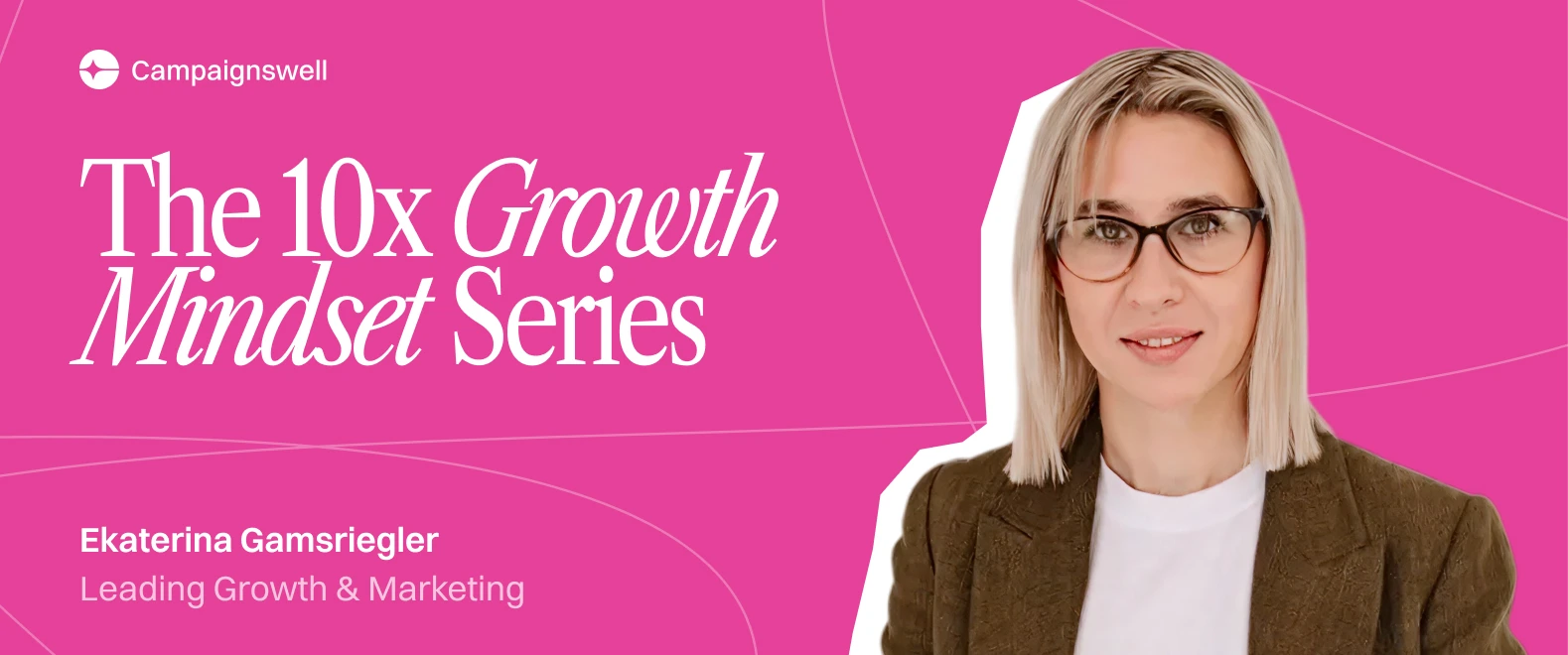
Welcome back to 10×Growth Mindset, our ongoing attempt to crack the system behind the app growth. We’re convinced the real unlock lies in how you think about the system, how clearly you see the funnel, and how quickly you turn signals into decisions. Tactics are useful, but they are not in the driver’s seat.
Today’s guest, Ekaterina Gamsriegler, likes to bring structure to growth efforts too. She’s been in marketing and growth for 15+ years, for the first nine — working on the full funnel from acquisition through retention to revenue. For the last six years, she’s been leading growth teams, advising B2C startups, and mentoring founders who wanted real answers. Today, she runs Growth and Marketing at MyGroove.
We asked Ekaterina to help us trade incremental polish for exponential lift, to point out the early traps that quietly kill momentum, and to spell out what she sees in teams that are actually ready to scale.
Campaignswell: Ekaterina, thanks for joining. Let’s start with the big question. When does a 10× goal even become realistic?
Ekaterina: It becomes realistic when you gain traction, reach product–market fit, and have at least one scalable way to bring in users. So, in addition to PMF, you need to figure out your Product–Channel Fit (if you’re not familiar with the term, check out this piece by Brian Balfour, who introduced the “4-fits framework”) and Channel-Model fit that covers monetization per channel. Unless you have a high virality factor that becomes your acquisition and retention driver, you will need a source of traffic that you can actually turn up, organic or paid. Once you’ve found at least one channel with an acceptable acquisition cost, you’ll want to scale it. And once you scale it, you’ll see how high the ceiling is. But, typically, before you reach the point of having one scalable channel, there’s a lot of experimentation and trial and error. For some companies, this takes just a few months. For others, it can take years.

The puzzle behind Product–Channel Fit
Campaignswell: What has to “click” for Product–Channel Fit?
Ekaterina: The pieces are easy to list but hard to align:
1) who your product is for and what value it brings;
2) when (in which context) you reach these people and through which channels;
3) how you communicate the value so that the message resonates; and
4) how you price and sell it to make sure that the perceived value > friction.
Once everything “clicks”, you can scale with more confidence. And then you need to do it over and over again, for each platform, channel, audience, or geo. And also when your product and acquisition strategies level up. So, the fun never really ends 😀
It’s critical to understand which strategies are “kindle” and which are “fire” (as Casey Winters puts it here), when you need one or the other, and which attributes of a channel matter. Sometimes you’ll need targeting granularity, sometimes a fast time-to-launch, sometimes — lower costs. Each channel has a right to exist in your mix, but it’s critical to be mindful of how you split resources. You should at all times understand why you’re spending them on some channel and not others, and what your goals are behind having each of the hundreds of possible channels in the mix.
Why teams stall at the start
Campaignswell: Do most teams approach this as a system early on?
Ekaterina: Usually not. Early on, very few teams think in processes and outcomes. And that’s okay. But when I say “processes”, I don’t mean building fancy org charts or documenting every minute of your working day. I mean, treating growth as a system and constantly evaluating the evidence and the new information that you’re getting in, which you are usually “buying” with your marketing spend.
In my opinion, figuring out the audience’s jobs to be done, your conversion funnel, or the channel/monetization fits early on is way more important than chasing “wow” moments like a splashy launch or a spike from a one-time “campaign”. Doing things that don’t scale can help you get the initial learnings about your users and for some teams and founders, non-scalable ops are simply non-negotiable. But they’re not a substitute for the systems that you’ll eventually need in order to grow 3-5x in a year or to become profitable in 6-12 months.

Why frameworks get skipped
Campaignswell: If frameworks help, why do teams skip them?
Ekaterina: Sometimes it’s because of the lack of knowledge of growth frameworks or mental models. Sometimes — because of the company’s mindset. I’ve seen setups where pace and optics were more important than outcomes, which typically leads to “busy-ness” that, best case, doesn’t move the needle; worst case — generates more bugs and accidents later on.
In my experience, bootstrapped companies, founders with technical or business backgrounds, or >1-time founders tend to bring structure, processes, and a data-informed mindset sooner. Companies with tighter constraints simply can’t survive without a growth model and an outcome-driven culture. There are even companies that introduce metrics like “revenue per employee” that, while imperfect, force you to think about efficiency and the relationship between headcount, focus areas, and real business value.
The three levers you always model
Campaignswell: If we break growth into core parts, what does the base model look like?
Ekaterina: I’ll lean on the framing I once heard from Joanna Lord in a podcast a few years back: “There are only three ways to grow a company: acquire more people in, retain them longer, or monetize them better. And for all three of those, you need a North Star metric and input metrics. And each of the input metrics should have loops or channels behind them.”
I couldn’t agree more with this. I do see growth in a similar way. But even if it sounds simple, it often requires hundreds of thankless iterations.
You can hack acquisition and conversion and thus buy yourself some time to sort out retention of those users coming through at a reasonable cost. Or you “win” in retention and activation and quickly figure out how to sell your product to users that keep returning. And if you can’t boast of a solid acquisition engine, good retention, and your conversion funnel is weak, then you have to fix it piece by piece.
In practice, I usually rely on a couple of techniques that function like an X-ray for the business:
1) a growth model (can be basic at the start) in a sheet where you track the key inputs that drives your north star metric(s). Track your main KPIs covering your user and customer acquisition, activation, retention, and conversion. Review monthly or every two weeks so nothing sags unnoticed.
2) a hierarchy of metrics / a metric tree that visualizes your main KPIs and clarifies what inputs roll up to outcomes like LTV, CAC, payback period, etc. This makes it easier to see what truly drives growth and where to focus optimization.
From experiments to systems
Campaignswell: Where should hypotheses come from so experimentation doesn’t turn into chaos?
Ekaterina: I still believe the strongest hypotheses come from data and from real users. Quantitative signals like a large share of users never reaching the paywall show you where the problems are. Qualitative signals like the reasons people cancel their trials or never start one help you understand why they happen.
And here’s the twist: experiment ideas can come from almost anywhere. A best practice you spot in a newsletter, a competitor’s new value proposition on the App Store, a hunch from your peer, even a comment from your niece learning piano. None of these sources are statistically meaningful on their own. But if you’re curious and paying attention, the world is full of inspiration for worthwhile experiments.
So the issue isn’t a lack of hypotheses, it’s a lack of resources. That means prioritization becomes the real dealbreaker. A few case studies about a new winning paywall design or a web checkout flow might deserve more weight (if this has impact on your target KPI). The same goes for ideas borrowed from competitors known for rigorous testing. Blind copying is a waste of time but borrowing selectively from sources that are data-savvy, contextually similar, or deeply experienced (e.g., an indirect competitor or a growth consultant in your vertical) gives you hypotheses that score higher on “confidence” and can rise to the top of your roadmap.

Product quality and the new reality of acquisition
Campaignswell: Some teams believe that a great product sells itself. Others focus on UA and monetization first. Where is the balance?
Ekaterina: 2-3 years ago, I would have said it without hesitation: start with the product. Retention either carries you or it sinks you, and no amount of onboarding tricks or a catchy paywall can save a weak core for long. And acquisition is easy to figure out with a strong core product. I still believe that.
What changed in the past years, however, is that the acquisition now is harder than 2-3 years ago. User expectations feel higher across most categories, and the competition in every niche got harder, which leaves fewer opportunities for creative or channel breakthroughs. So my advice gets slightly adjusted: get the product to a level where it truly delivers value, retains, and sells, but also start thinking sooner about where and how you’re going to acquire users because the room for error in UA is smaller than it used to be.
And if you want to test an acquisition channel when the product and the funnel are not yet “ready”, be deliberate about your goals and focus on learnings rather than positive ROAS.
Metrics that actually drive decisions
Campaignswell: Let’s talk metrics. Which ones truly help a team make strategic decisions for fast, large-scale growth, and which ones distract?
Ekaterina: The classic split still applies: vanity metrics also known as the scoreboard, can motivate the team early on, but when I see a large number or a positive trend for a KPI expressed in absolute numbers, the main question is: at what cost? If we’re not looking at ratios and costs-per-events across different breakdowns, such scoreboards are not telling us much. This works as a snapshot, at a high level.
A funnel or the performance of your core growth loops is valuable for a deeper dive. Track the dropoffs and the costs of each critical step. Make sure to break the funnels and loops down by platform (user behavior differs a lot depending on the OS or mobile/web), channel, geo, and user motive if you can.
Campaignswell: In your recent talk, you said, “The biggest UA wins aren’t really about UA.” What did you mean?
Ekaterina: Sometimes there are wins at the top of the funnel that we love to celebrate: a new concept that pops, store screenshots that double conversion, a video with CTR three times the norm… they spike, then they fade, which is normal and we keep iterating. I, however, don’t expect such wins to carry a 2–3x step change in the bottom line in the long run.
In the past years, I’ve seen the biggest and durable UA wins originating from the funnel improvements. If you manage to lift trial and purchase conversion, the same budget produces more of high-quality events, and ad platforms optimize better on those signals. That’s when acquisition becomes easy to scale.
For example, back in my days at Mimo, a couple of paywall experiments increased purchase conversion on Android by about 40%. Only after that could we profitably scale Google Ads. On iOS, a few years back we also invested a lot of effort into paywall and pricing experiments and increased the conversion to purchase by >50%. Then we scaled Meta Ads with healthy unit economics. More users started the trial, more converted after, the LTV went up, and CAC stopped choking us. Before that, LTV sat below the acquisition cost, so pushing spend was making no sense.

Team setup that can actually deliver 10×
Campaignswell: From the teams you’ve seen actually grow, what team setup do they run with?
Ekaterina: On the marketing side, at least: paid acquisition (one or several people, depending on the spend level and the number of products managed), organic acquisition (ASO), and if the website is a real lever, someone owning it. It might be a T-shaped digital marketer or a dedicated SEO manager. A marketing designer who likes making ads is a huge asset. Paired with this, I enjoy working with developers who ship experiments on monetization and activation across iOS/Android/Web, and a product designer. This kind of a setup can handle both iterative optimizations and the bigger, higher-effort growth bets.
Campaignswell: In your experience, what day-to-day working model keeps teams growing, and what version of it reliably fails?
Ekaterina: There’s one setup (fairly common) that I see regularly failing: marketing brings users (i.e., installs or website visits) and the product “steps in” to watch conversion and revenue. Marketing is treated as “creative and spending money,” product as “data-driven and responsible for the outcomes.” In my opinion, this setup is fundamentally wrong.
The healthier setup is cross-functional accountability for growth. One team with shared goals, or a few teams in constant, honest communication, looking at the same dashboards and answering the same questions every day: What happened last week? Why did the revenue dip this week? Why is the CAC up or the ROAS below the forecast? The exact mix can vary: marketers, a PM, a designer, paid acquisition managers, and engineers, but the principle is one lane and a shared truth.
Rituals matter: short, on-point standups; reviews of what’s been shipped, what’s launching, what worked. You can try to mimic this inside functional silos with a weekly “metrics” meeting, but for me, it’s more of an artificial substitute. It works worse than a team that actually lives in the same growth context.
In my ideal setup, every marketer is effectively a product marketer, and everyone in product, including developers, has a baseline respect and understanding of marketing and acquisition levers. That cross-pollination builds a true growth mindset and removes finger-pointing (“bad traffic,” “a failed paywall test,” “broken tracking”). We still get to the truth when something breaks, but the goal isn’t to find a culprit; it’s to understand the chain of events and fix it. When people operate as one team, looking at the same data daily, bad surprises are rarer and easier to anticipate.
I really love the concept of “intellectual honesty” and I find it difficult to achieve real growth in teams without it. In her article, Wes Kao describes it as: “seeking the truth and aiming to be accurate in your thinking and communication. It means having an evidence-based approach where you consider relevant information even if it contradicts your beliefs.”
And there are two more ingredients teams often overlook: skill and confidence. The teams that keep growing share a calm belief that “we can figure this out,” even if the “how” isn’t obvious today. That belief, paired with data, reduces blame culture, speeds up diagnosis, and keeps people focused on solving the problems together instead of defending turf.
Tooling: what is truly a must-have (and what can wait)
Campaignswell: What is your tooling stack at a minimum?
Ekaterina: The non-negotiable is a strong product analytics tool for user behavior analysis — Mixpanel, Amplitude, PostHog, somewhere all events land, so you can slice the funnel any way you need. App Store Connect / Google Play aren’t enough for that.
ASO tools are important for me early on, too: AppTweak, AppFollow, AppFigures, etc. An MMP or SDKs help when you’re actually spending, which will probably not be day one. Lifecycle tools (email/push) matter when you already have a sizable userbase and a product where external communication triggers help.
And one more thing I’d put close to must-have: tools that let you test paywalls and/or onboardings without shipping new app releases. Being able to iterate on pricing, paywall designs, and messaging quickly is a huge unlock for speed and learnings.

The real secret weapon
Campaignswell: If you generalize, what characterizes teams that keep compounding?
Ekaterina: A blend of data-driven thinking, intellectual honesty, and the stamina to find and solve problems again and again. You fix one constraint and another one appears, cancellations or crash rates rise, or something else breaks. Bottlenecks migrate. You need skills and creativity to keep solving, and the confidence that even if you don’t know the answer today, you’ll figure it out soon.
Last call to lock in 10× Growth this year
Hey growth people 🙌 If your plan for next year still involves “we’ll watch ROAS and see,” welcome, you’re among friends.
That exact headache is what pushed us to build Campaignswell. It’s a SaaS BI platform for teams who are tired of stitching together dashboards, arguing over numbers, and explaining to the CFO why “it should work later.” Campaignswell pulls marketing, product, and revenue into one place and shows how things actually connect in your funnel.
You get a real click-to-revenue view, predictive LTV and ROI, cohort forecasts, and creative-level signals that tell you what’s worth scaling and what’s about to burn budget quietly. The kind of clarity you want before doubling spend, not after the post-mortem.
If you want to see this on your own data, let’s keep it simple.
Book a demo. We’ll look at your setup, sanity-check the numbers, and see what’s really driving growth.

Co-founder & CEO at Campaignswell
Book a demo


Co-founder at Campaignswell
Use the session to ask your hardest questions about scaling, LTV, or attribution, and see how full-funnel predictive analytics gives you clear, actionable answers.

10x Growth Mindset from a BetterMe and Replika growth leader: The uncomfortable truths behind scaling subscription apps
10× Growth Mindset: The real reason teams stop at $10K–$100K in spend
10x Growth Mindset from a Meta insider: What matters more than algorithm tactics for subscription apps on Meta
The 10× Growth Mindset: field notes from growth expert who scaled 100+ apps