10x Growth Mindset from a BetterMe and Replika growth leader: The uncomfortable truths behind scaling subscription apps
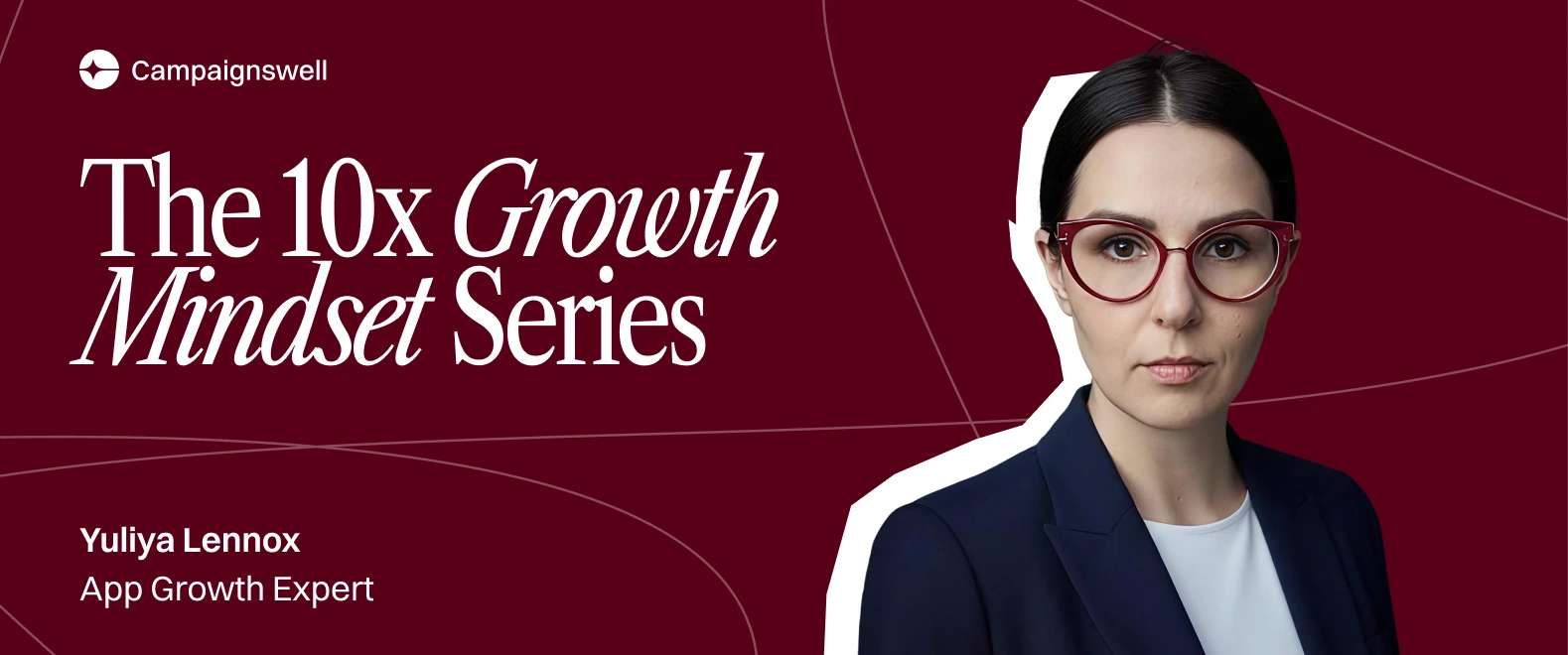
Welcome back to the 10× Growth Mindset series. Every interview in this series is a chance to look at growth from the inside, through the eyes of people who have built it under real pressure. We talk about the decisions behind breakout moments, the messy middle before things start working, and the systems that help companies move from “nice traction” to serious scale.
This time, we’re talking to someone who has seen growth from several angles: as a CMO-level operator, agency founder, and now product leader building for a deeply human category.
Yulia Lennox is a serial marketer and founder of Lennox49 performance marketing agency, with over 10 years of CMO-level experience at high-growth tech companies. She helped build BetterMe's marketing from the ground up, scaled Replika's revenue to over $50M ARR, and took a small bootstrapped language-learning app to second place in its category, right behind Duolingo. Today, Yulia's role as General Manager at Beacon Software puts all of that experience to work where it matters most — building a product that changes the lives of mothers worldwide.
In this interview, we talk about what 10× growth looks like when it’s built by someone who knows both the numbers and the people behind them: how to find the right market opening, build a team that can keep up with the pace, and make decisions that still hold when the stakes get bigger.
Sharpen the axe before you pour money into Meta
Campaignswell: At what stage of a subscription app’s growth should a founder start aiming for 10x growth, and why does that moment matter?
Yulia Lennox: For me, the right moment is when you have already spent at least $10,000 on a specific setup and you understand that it works.
By setup, I mean the whole thing: your onboarding, your web funnel, your ads, your positioning, the way analytics is configured, and the unit economics behind it. I almost never use the word “bundle” or “setup” like this, because it sounds a bit too performance-marketing-core, but here it fits.
If you have spent less than $10,000 and you still haven’t seen ROAS, I would never start scaling. I don’t believe in this “let’s scale for one or two days and maybe it will bring us 10x” logic. That’s usually how teams burn money and then say the channel doesn’t work.
You scale when you have spent enough money to see real signals. First you check whether your positioning works. Then you check whether your analytics is correct. Then you check whether the economics comes together. Only after that does it make sense to increase volume.
I love that quote about the axe: if I had seven hours to chop down a tree, I’d spend six hours sharpening the axe. That’s exactly how I think about growth. You prepare the system first, then you scale it.
The teams that win are annoyingly interested in what they build
Campaignswell: From the dozens of apps you’ve worked with, what patterns consistently separated the ones that broke through from the ones that plateaued?
Yulia Lennox: The strongest pattern is genuine interest. In the companies that really grew, people cared about what they were building. You could talk to almost anyone on the team, and they would spend an hour telling you what they did, why they did it, how it changed the product, and what they wanted to improve next. It mattered to them.
That is very different from a company where the founder pushes everyone and the team simply executes because it’s their job. You feel the difference immediately.
I see more and more people now looking for UA roles or IT jobs simply because they want a stable job and decent money. And of course, that’s normal. People need to work. But when we started, a lot of this industry was driven by curiosity. It was genuinely exciting. The people who still feel that excitement are usually the ones who win.
Another big pattern is the personality of the CEO or founder. The person driving the company matters a lot. Their standards, their energy, the way they work, the way they treat people, the way they make decisions.
I’ve never had great results with bad people. Every time I met genuinely good people who cared about what they were doing, they usually ended up building very strong products.

The “why aren’t we profitable yet?” trap
Campaignswell: What’s a common misconception most app founders have that actually blocks their growth?
Yulia Lennox: The most dangerous misconception is expecting the app or business to start making money immediately.
I’ve worked with very different companies. Some were like Genesis, with a lot of money and a lot of people. Others started from zero, or raised a small amount of VC money and had to survive on that. Across all of them, this expectation can become a real problem.
Of course, you want to help founders. You want them to make money. You want the business to become profitable as soon as possible. But in reality, before you start earning consistently, you usually need to get a lot of bruises. Every business is different. Something that worked for one team can easily fail for another. You need to run many tests before you can honestly say, “Okay, now we can scale.”
A lot of founders also struggle emotionally with the fact that the business can be unprofitable at the beginning. Even when early results are good, they start asking, “We had 200% profitability at the start, why can’t we now spend a million with the same profitability?”
But everyone who has done this understands that the first results are often the best numbers the app will ever see. Early traffic can be the easiest traffic. Early pockets can convert beautifully. Then the reality starts.
Founders can get stuck on those first numbers. They had one great result, and then they measure everything against it instead of looking at the full picture. This is especially painful for bootstrapped founders, because every dollar feels personal.
For companies with endless money and endless resources, the blocker is often pride. You get a strong result, and suddenly you start thinking you know everything. That’s a trap. You have to bring yourself back to earth all the time and ask, “What don’t we know yet? What haven’t we tried? How can we keep moving?”
If you don’t do that, you get stuck at some level and can’t scale further.
Campaignswell: Is there a “normal” period when the business is still unprofitable, but it doesn’t mean everything is broken?
Yulia Lennox: Yes, but it depends a lot on who is doing the work. If you’re a founder doing everything yourself, and it’s your first time opening Meta Ads Manager, that’s one timeline. You’ll need more time simply because you’re learning the system while building the business.
But if you have people who have done this before, and they’re good people, meaning they’re not just trying to take your money, they’re actually working to launch and improve ads, then you should start seeing signals in the first few months.
Actually, in the first month you should already get signals. Even the first two weeks of traffic can tell you a lot, even if you’re spending only $100 to $500 per day. You can already understand whether the product you have right now can potentially give you what you want, or whether something important is missing.
By the second or third month of traffic, you should reach numbers that feel comfortable enough for you to decide whether the business can pay back.
Usually, at this stage, you should at least be around confident break-even in the short term. If you’re not getting close to zero by then, it means you need more experiments with the product, the marketing, or both.
If after six months nothing has worked, then, honestly, change the team, change yourself, or change the product. But before making any dramatic conclusions, check that everything is actually set up correctly.
Because to make the economics work, you need the right creatives, the right funnel, the right pre-landing pages, the right monetization, and the right team mindset. You also need the right approach to experiments.
You can spend six months running the same thing and hoping something magically changes. Or you can run your first experiment after two weeks, the second after four weeks, and keep going. By month six, you may have run enough experiments that your product is already different, your monetization finally works, and everyone is much happier.

Billion-dollar teams don’t wait for a perfect Jira ticket
Campaignswell: When you first meet a team, what signals tell you they have both the mindset and the execution ability to scale 10x?
Yulia Lennox: A very strong signal is the culture of work. I’ll use Higgsfield as an example. What I personally did for them was very small, but from the beginning it was clear that the company had a real chance to win. Today, they are one of the biggest and coolest companies on the market, and they grew from zero to a billion-dollar valuation.
The thing you could see from the start was how seriously they worked. There weren’t people who came in, spent five hours doing something, and left. They were putting in 16-hour days and sometimes even sleeping at the office. I know work-life balance is very important to many people now, and I understand that. But if you want to build something huge, there is a phase where the intensity is simply different.
You probably don’t build a billion-dollar company by spending every day telling everyone how great they are instead of asking them to do better work. The companies that grow strongly usually have strong leaders who push the team. That’s normal. Some people dislike it, and I understand why. But when people love their work and care about the mission, that pressure often pays off.
It was similar at BetterMe in the early days. People worked a lot. Now the company has more people and more structure, but you still know they are working seriously. They are not sitting around drinking coffee all day. They are building.
Campaignswell: On the flip side, what red flags immediately tell you they’ll stall unless something changes?
Yulia Lennox: One red flag is when every task immediately turns into bureaucracy.
For example, I give someone a task, and they say, “Please write to our project manager so they can put it in the backlog, then we’ll estimate it, then we’ll come back to you.” At that moment, I usually think, “Guys, unfortunately, this probably won’t work.”
Of course, task descriptions matter. Workflows matter. Doing things properly matters. But when your communication around achieving a goal turns into “nobody officially assigned this to me,” the company starts falling apart.
For me, this is still about more than a job. We are building a company. We are creating value for people. If someone sees their role as simply closing four work points in Jira, that’s a problem. And if the whole company behaves like that, it becomes a very strong red flag.
When people care more about how the task was assigned than about what problem we are solving, growth gets very hard.
Another red flag is toxicity. I said earlier that managers need to push people, and I believe that. But if the atmosphere is truly toxic, people will want to leave. And they will leave. Then building anything becomes much harder.
Sometimes a company can survive this because the founder is extremely strong or because salaries are very high. But in general, it’s better when people feel good. It’s better when people are taken care of. At least that’s how I see it.
The expensive lesson: “our product is different” can cost you a growth channel
Campaignswell: Can you walk through a real example where a team underestimated something important, got stuck in scaling, then fixed it and everything started working?
Yulia Lennox: Yes. My biggest example is Replika and web funnels. And honestly, I still see it as my personal failure.
At that time, web funnels were already growing across the market. We could see that this approach was working for other products. But I looked at Replika and thought, “No, our product is different. It’s too specific. You can’t build a good enough web funnel for this. What questions would we even ask?”
And I was wrong.
We entered web funnels later than we should have. That’s the painful part. It wasn’t that we didn’t have a product, or traffic, or a team. We had all of that. We were already one of the biggest players in the market, and maybe that was exactly the problem. There was some overconfidence in it. We thought we understood our category better than the market did.
Later, when we finally took web funnels seriously, they worked. The product grew well. But I still think we could have learned faster, tested earlier, and entered that playbook before it became obvious to everyone.
The lesson for me was very simple: never decide that something won’t work for your product before you test it. Especially if the market is already giving you signals.
Math-brained founders have an unfair advantage
Campaignswell: Do you see any correlation between founders’ backgrounds and how well they scale? For example, are technical or math-heavy founders more likely to succeed at scaling?
Yulia Lennox: Oh yeah, big time.
If a founder has a math, physics, technical, or financial background, that’s a huge plus. The most successful people I’ve worked with usually had either a financial or mathematical background.
That helps a lot because they can actually read analytics. They can see when things are going well, when things are going badly, and which signals matter. They look at the right things.
I’ve met apps that had almost no analytics at all. No Amplitude, no normal tracking, nothing. They were living purely on vibes: “Today we made a lot of money, tomorrow we made less money.” They didn’t know where their traffic came from, how it correlated with anything, or what was happening inside the app.
A founder who understands numbers usually wouldn’t allow that. They would need to know what is happening.
But there’s another side. Sometimes background doesn’t matter as much if the person has a very strong idea and understands why they’re building the product. You can build apps that solve no real problem and simply make money. Or you can build apps that matter for humanity.
In the second case, what you want to say, what problem you solve, and why it matters can be more important than staring at numbers all day.
So yes, math and technical backgrounds help a lot. But there are different cases. A strong idea and a real mission can also carry a company very far.
Compounding growth starts with one annoying question
Campaignswell: What’s the biggest difference in mindset and daily behavior between founders chasing quick wins and those building compounding growth? What does that discipline actually look like day to day?
Yulia Lennox: The biggest difference is that compounding-growth founders are never really done. They don’t wake up thinking, “Great, yesterday worked, let’s just repeat it.” They ask, “What can be better today?”
You spent $100K yesterday. Great. Why wasn’t it $150K? What blocked us? Was it creatives? The funnel? The product? The team? The budget? The decision-making speed?
That’s the daily discipline. You keep asking uncomfortable questions, even when the team is already working hard. And yes, you need to trust your team. But trust doesn’t mean you stop pushing.
That’s usually how strong founders think. “Enough” is not really their favorite word. They see someone build a billion-dollar company and instead of thinking, “Wow, good for them,” they think, “Okay, what would it take for us to get there?”
And the funny thing is, many of these people are not doing it for the fancy lifestyle. They drive regular cars, live in regular houses, and still obsess over the business. They just like building. They like seeing the numbers move. That’s the game for them. And you need that energy inside the team too.
There’s also one trap I see a lot.
A team finds a marketing channel that works, starts making money, and suddenly marketing becomes the answer to everything. It becomes the cash cow when things are good and the scapegoat when things slow down.
But compounding growth doesn’t come from marketing alone. You still need to work on the product all the time. You need to talk to users, watch retention, understand why people stay, and why they leave.
That’s something I really respected at Replika. The founder was personally close to the product and the users. She talked to customers herself, did customer development, and genuinely cared about what people experienced inside the product.
Because you can sell a subscription once with good marketing. But if retention is weak, you don’t have a growth system, you have a leaking bucket with nice ads on top.
So for me, the discipline is this: keep pushing marketing, keep improving the product, and never let a good result make you comfortable.

The 10x shopping list every founder wants, and the order that changes everything
Campaignswell: Let’s imagine a team is fully committed to achieving 10x growth. How would you prioritize these factors:
- a world-class UA expert,
- strong analytics,
- a predictive engine,
- a high-output creative machine,
- web funnels,
- a great product,
- investor or UA funding,
- a strong CMO,
- a cool product designer,
- and founder passion?
Why in that order? And is there anything critical missing from this list?
Yulia Lennox: I’d put analytics first.
Second, a high-output creative machine.
Third, web funnels.
Fourth, a great product.
After that, you can do whatever you want.
Analytics matters most because if you see the wrong numbers, or you don’t understand what works, you can’t scale. You’ll just push money into the fog and hope the fog is profitable. Good luck explaining that to finance.
Creatives are the most important execution layer. A good creative can make or break the whole company. Honestly, I’m in this business because at some point I found a creative that worked incredibly well. I’ve never done drugs, but that feeling, when a creative starts working, is a high you chase your whole life.
Funnels matter too. Web funnels, and good funnels inside the app. At the same time, I’ve realized that apps can still exist without web funnels if the app is genuinely needed. If it’s not just another “funnel product,” it can still work and make money.
A good product matters because it makes predictions work. The quality of the product affects whether monthly subscriptions rebill seven times or once, or even worse, get refunded. So yes, you definitely want a good product.
A world-class UA expert is nice to have, of course. But weirdly enough, UA is the easiest profession in the world right now. With how ad accounts work today, it’s actually hard to be a terrible UA expert unless you spend five minutes a day there.
When your product converts well and your creatives convert well, you don’t need to spend hours monitoring campaigns every day. So I don’t think the UA expert is the biggest growth lever.
A strong CMO? Honestly, you don’t always need one. Of course, having a CMO can be good. I was a CMO for a long time myself. But do you need a CMO before you have revenue or strong market fit? I don’t think so.
You can work with one UA manager until you reach several million per month. And even then, there are questions. Instead of hiring a CMO too early, hire five designers who can produce creatives.
A CMO becomes useful when you have too many traffic sources, too many people to manage, and the system is genuinely large. If the system is small, the CMO should be hands-on. Your CMO should be your doer. If you have a five-person project and the CMO says, “I’ll hire more people under me,” I’d say thank you, but no.
Founder passion is important. In the earliest stage, it’s better when the founder becomes a bit of a marketer, ideally a strong marketer.
At EWA Learn English, for example, the founder discovered a real talent for marketing. He became very interested in it, figured things out himself, started buying traffic himself, and the company grew a lot, including through web funnels. I was very proud of him because that’s exactly what a founder needs.
A founder needs to understand marketing well enough to know they’re not being fooled in acquisition. Because, let’s be honest, a UA person can work one hour a day, or sometimes avoid the ad account for days. With agencies, this often happens. You later check how often they made changes or paused anything, and it turns out they opened your ad account once every two weeks. Great, very inspiring. Probably not what we need.
So yes, founder passion matters because it motivates the team. But founder understanding matters too. You need to know enough to protect the company.
Campaignswell: In your experience, how does the order of focus between product and marketing shape outcomes? Can you share examples of teams that won or lost based on choosing the right or wrong first move?
Yulia Lennox: Globally, I’d say you need a decent product first, then you test marketing, then you improve the product and search for monetization.
Although, honestly, coming from subscription marketing, I would probably test marketing first. Then I’d build the product.
So the practical version is this: first, use marketing to check whether the product idea has potential. Then build a good enough product. Then look for monetization. Then start scaling, while continuing to improve the product seriously.
Duolingo is a good example here. Since I worked in the education category, I watched them closely. Before 2019, their marketing was very basic. You could look at it and think, “Okay, this is nothing special.” At the same time, our bootstrapped app was getting close to their results. We were number two after Duolingo, while they had $50 million to launch things like podcasts at that time.
They weren’t doing much performance marketing. But they had built a product that worked really well. They also created visibility, meaning marketing in the broader sense: PR, awareness, things we usually avoid because they don’t bring money immediately.
Then, when they finally started marketing properly and went full speed, they began making something like $5 million to $20 million per month. Why? Because they had already sharpened the axe very well.
That’s the order I believe in: test with marketing, then create and improve the product until it becomes worthy of serious marketing.

Which metric would you trust with your next $100K?
Campaignswell: What tools or systems do you consider the most powerful for scaling fast without killing ROI?
Yulia Lennox: If I knew the perfect answer, I’d probably be giving this interview from my private island. But seriously, I don’t think there’s one magic tool that lets you scale fast without ROI dropping. The main test is much simpler, and honestly, a bit brutal: can your product survive more spend?
Let’s say one creative starts working. You increase the budget from $100 to $200, and everything breaks. ROI drops, conversion drops, the whole thing falls apart. That usually means you’re not ready for fast scaling yet. You need to move slowly, raise budgets carefully, maybe 10% a day, keep testing, keep adjusting.
But when something really hits, it feels different. You can keep adding budget, and it still works. ROI doesn’t collapse. That’s usually when you know you’ve found a real point of leverage. The creative works, the funnel works, and what happens inside the app supports the promise you made in the ad.
That’s why I don’t really believe in a separate “tool” that saves you here. The good and the bad news usually happen in the same place: your ad account.
That’s where you see whether you actually have something scalable, or whether you just had one cute result that dies the moment you touch the budget.
So the answer is boring, but true: if ROI holds as spend grows, scale faster. If ROI falls apart, scale slower. Wow, such genius advice, I know. But in practice, this is still what it comes down to.
Campaignswell: What metrics do you personally look at to understand whether a growth system is actually healthy?
Yulia Lennox: I look at the money. Money and conversion rates. Of course, you can look at CTR, CPM, CPI, all of that. And probably, the more metrics you understand, the better. But any real UA person still comes back to money.
I don’t care how expensive something looks at the top of the funnel if it converts into profit later. If ROAS works, I’m interested.
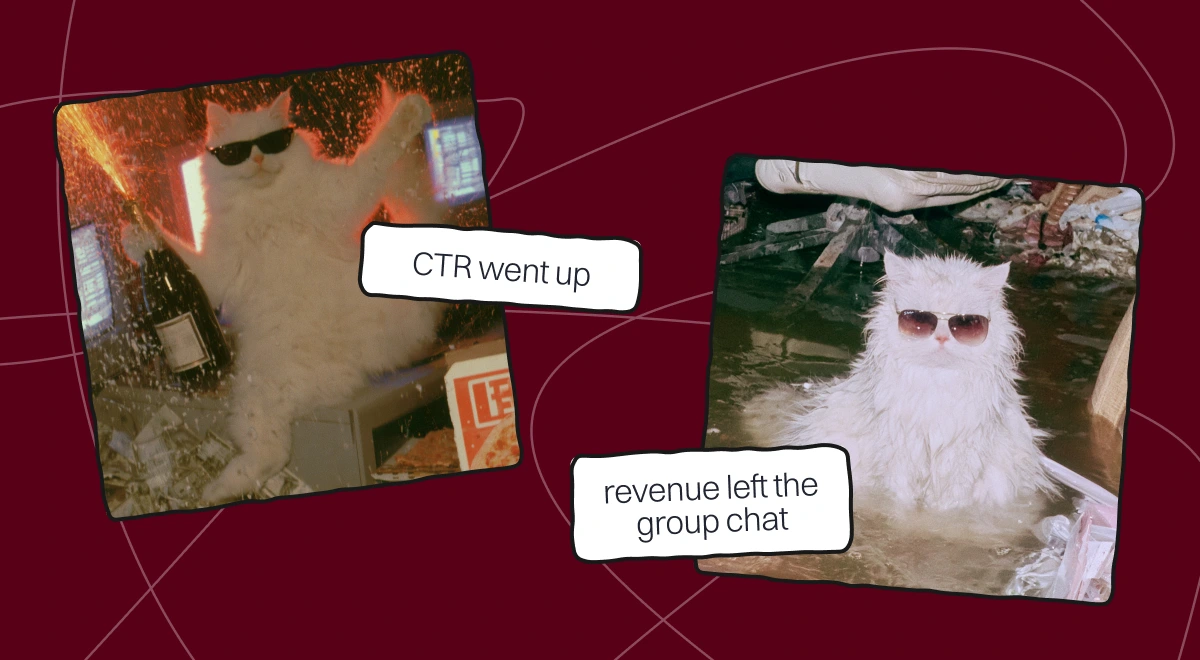
A lot of teams get excited about the wrong wins. “Our CPM went down.” Great. Did ROAS improve? “Our CTR went up.” Nice. Did revenue move? If nothing changed in the economics, then what exactly are we celebrating?
That doesn’t mean these metrics are useless. If CTR is strong, you can use that signal. Maybe the creative angle works, and now you need to improve the funnel. If people click but don’t buy, something is broken after the ad. Every metric can help you understand where to work next.
But if someone comes to a marketing meeting every day and says, “Today CTR is this, CPM is that,” while the business spent $500 and got no meaningful result, that conversation is basically noise.
From a CMO or a CEO perspective, I’d rather talk about money first. It keeps everyone focused on what actually matters. If I was working purely as a UA manager, I would look at every metric available, because that’s part of the job. But when something truly works, a lot of these details become secondary.
A scalable creative can have a terrible CTR and still bring incredible conversion. And if it makes money, you’re not going to reject it because one metric looks ugly.
App developers are entering the “prove your value” era
Campaignswell: How has vibe coding and the rise of indie app developers changed the industry, and how do you see that continuing?
Yulia Lennox: Vibe coding is very cool, obviously. But right now, I think the people who really benefit from it are still people who already understand the industry. If someone can use it to build something useful today, they probably already had enough knowledge to launch a small app anyway.
What I find much more exciting is the idea of personal app creation becoming mainstream.
I really believe in Wabi, the new project from Replika’s founder, Eugenia. That’s exactly where I think things are going: you don’t code an app, you just say what you need. “Give me an app that tracks my weight.” And in a few seconds, you have it. You can tweak it, or you can use it as it is. It becomes your personal set of apps, made for you.
That changes the whole logic of the market. Why should I pay for some simple app I barely use, just because someone built it and put it in the App Store? AI can already create a lot of that. In a couple of years, it will do it even better.
So I think platforms where users create their own apps are the future for many simple use cases. Especially for products that exist because they’re fun for a moment, or useful in a very basic way, and people are willing to pay for that small convenience.
But I still believe real products will survive. Good apps with strong functionality, real value, and a human touch will still matter. Where you need taste, product thinking, emotional intelligence, and a real understanding of users, one person with AI won’t replace everything. Those products will still be needed. Maybe even more than before.
Campaignswell: What used to work in app scaling a couple of years ago that simply doesn’t work anymore in 2026?
Yulia Lennox: Scam. Absolutely. The way Meta and payment systems are fighting what web funnels have become is already very serious. And honestly, good. It had to happen.
A few years ago, many teams could get away with very aggressive flows. You could say, “Subscribe for $0,” and hide the real price somewhere nobody would properly notice until the trial ended. That kind of thing became way too common.
Now it’s much harder. You can’t just promise something for free and fail to clearly explain how much the user will be charged later. Platforms and payment providers are pushing back, and I think that’s healthy for the market.
Black hat tactics damaged trust. They hurt trust in products, in online payments, in subscriptions, in the whole category. Users got burned too many times.
I’d really like to see the market move away from that. Build white-hat products. Build things people actually want to pay for. Don’t trick them into paying.
This also connects to brand. When I talk about strong companies, this is what I mean. If you build something people genuinely need, and your whole goal is not simply to extract money from them, you’ll have a much better chance long-term.
Of course, every business exists to make money. Let’s not pretend otherwise. But there’s a difference between making money because you create value and making money because you caught someone in a payment trap.
I believe products with a real idea have much more potential. They live longer, they’re more interesting to work on, and in the long run, they win more often.
Yes, there are still plenty of apps that make a lot of money while giving almost no value. That’s sad, but it’s real. Still, I don’t think that’s where the best companies will be built.
A small note from the Campaignswell team
The Campaignswell team that prepared this interview believes in the power of analytics and clear data too. Mostly because we’ve seen what happens when growth teams finally have numbers they can trust: across 100+ clients, apps and games have grown 3–30x with better visibility, sharper forecasts, and fewer “okay, let’s just hope this works” moments.
So if you’re also trying to make growth for your app or game more predictable and easier to manage, we’d be happy to help.
Campaignswell connects your marketing, product, and revenue data in one place and helps you see the things that usually stay buried in dashboards, spreadsheets, or someone’s “I’ll check it later” backlog: what’s ready to scale, what needs another test, which cohorts are likely to pay back, and where budget is quietly leaking.
Basically, we help you sharpen the axe before you pour more money into the next campaign.
Book a demo and let’s look at what predictable growth could look like for your app or game.

Co-founder & CEO at Campaignswell
Book a demo


Co-founder at Campaignswell
Use the session to ask your hardest questions about scaling, LTV, or attribution, and see how full-funnel predictive analytics gives you clear, actionable answers.
10× Growth Mindset: The real reason teams stop at $10K–$100K in spend
10x Growth Mindset from a Meta insider: What matters more than algorithm tactics for subscription apps on Meta
10× Growth Mindset: How app founders engineer a system for repeatable wins and forecastable outcomes
The 10× Growth Mindset: field notes from growth expert who scaled 100+ apps