
Scaling hybrid-casual UA: x2 monthly spend and +30% margin profit at Highcore Games

Before
- As IAP grew, young cohorts became harder to read with basic predictions and MMP data
- The team needed more granular data for UA decisions
- Budget changes relied too much on incomplete cohort data
- Lacked reliable predictions to spot scalable young cohorts early enough
- Scaling became harder to connect with margin goals
With Campaignswell
- Earlier benchmarks for young cohort performance
- Cohort-level predictions across campaigns, sources, creatives, platforms, and geos
- Normalized net revenue used together with predictive metrics
- Clearer view of which campaigns to scale, hold, or reduce
- Budget planning became more structured and tied to margin impact
- Monthly spend roughly doubled, with around 30% growth in margin profit
About Highcore Games
Highcore Games approached Campaignswell at a stage where the project was already growing, but the next phase required more predictability, more granular cohort visibility, and a clearer connection between UA decisions and business goals.
The team had already built a working UA process around early cohort signals, campaign performance, and regular budget reallocation. That setup worked well while the product was more ad-heavy and revenue curves were easier to read. As the game became deeper and monetization shifted toward a more hybrid model, IAP started to play a more meaningful role in total revenue. That changed the way the team had to evaluate cohorts, campaigns, creatives, platforms, and geos.
For Highcore, the question was not whether the project could grow. The question was how to manage that growth with enough confidence:
- how to understand young cohorts earlier,
- how to normalize revenue for planning,
- how to avoid overreacting to incomplete data,
- how to connect UA decisions with margin goals.
Why hybrid monetization needed a stronger prediction layer
Before Campaignswell, Highcore already used predictive logic in UA planning. For an earlier, more ad-driven version of the project, a simpler cohort-based model was enough to guide day-to-day decisions. Ad monetization followed a more familiar curve, and the team could make many calls using early revenue and retention signals.
As the product became more hybrid, the picture became more complex. IAP contributed a larger share of revenue, and payer behavior was less uniform across cohorts. Different campaign types, geos, platforms, and creatives could produce very different revenue curves. Some cohorts needed more time to mature, while others showed earlier signs of whether they fit the target payback window.
That made the team’s requirements more demanding. Highcore needed a stronger predictive layer that could help:
- evaluate young cohorts earlier,
- work with more granular cuts of data,
- support decisions before campaigns had already spent too much to adjust efficiently.
The team also needed a more precise net revenue view for planning. MMP data remained an important source layer, but business planning required revenue normalized across store fees, taxes, platforms, and geos. At scale, these differences matter: even small gaps in net revenue logic can affect how a campaign, source, or creative is evaluated.
Why Highcore chose Campaignswell
Highcore chose Campaignswell for several reasons.
First, the team wanted an independent analytics layer. Campaignswell was not tied to a publisher, game company, or traffic ecosystem, which made it a better fit for unbiased UA evaluation.
Second, Campaignswell was built specifically around marketing analytics, cohort performance, and predictive decision-making. Highcore was not looking for a generic BI layer. The team needed a tool that could support practical UA questions: which campaigns are healthy, which cohorts are developing as expected, where spend can be increased, and where the data suggests caution.
Third, the team valued the partner-style support. For Highcore, it was important to work with a team that could help investigate edge cases, discuss cohort behavior, support retargeting and reattribution questions, and improve the setup together over time. The value was not only in the dashboard, but also in the ability to resolve complex cases faster.
What changed after Campaignswell entered the stack
Campaignswell became part of a broader shift in how Highcore managed growth. The product was becoming more hybrid, UA was operating at a higher level of complexity, and the team needed a clearer way to connect performance signals with business goals.
1. Young cohorts became easier to evaluate
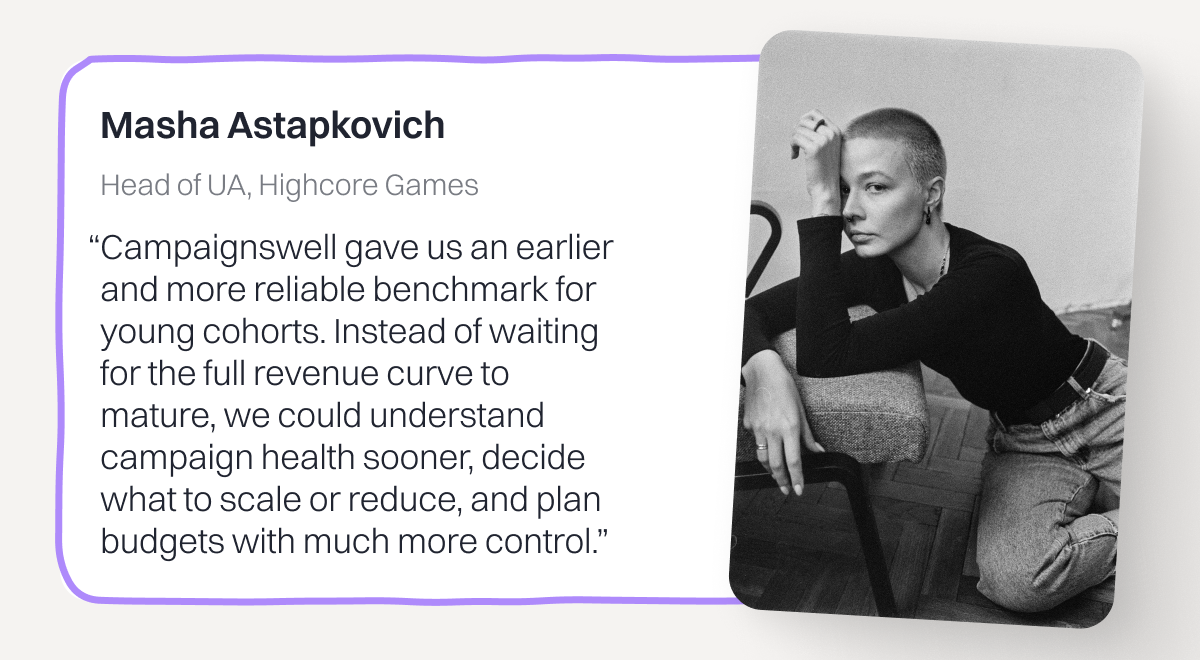
Campaignswell gave Highcore an earlier benchmark for understanding campaign performance while cohorts were still maturing. Instead of waiting for a full revenue curve to close, the team could compare young cohorts against historical behavior and understand whether they were developing in a healthy direction.
This did not remove uncertainty completely, but it gave the team a more reliable orientation point. That made it easier to decide what to hold, what to scale, and what to reduce before spend decisions became too expensive to reverse.
2. Budget planning became calmer and more structured
With a stronger predictive layer, Highcore could manage spend with more control. The team could identify weaker areas earlier and redirect budget toward campaigns, sources, and creatives that better matched their goals.
The main benefit was not simply “spending more”. It was being able to plan spend more deliberately, with a clearer view of expected cohort development and margin impact.
3. The team got more time for higher-value work
Before Campaignswell, part of the team’s time went into manual checks, repeated calculations, and preparation of views needed for UA decisions. Moving more of that work into Campaignswell reduced the operational load.
That gave the team more time for work that actually moves performance: hypotheses, research, creative analysis, source testing, and deeper investigation of cohort behavior.
4. Analysis became more granular
Campaignswell helped Highcore look beyond top-level campaign performance. The team could work with more granular views across cohorts, creatives, sources, platforms, and geos.
That mattered because surface-level performance can hide important differences. A creative or source can look promising at first, but later fall outside the target payback window. With more granular visibility, Highcore could better understand where performance was coming from and which parts of the mix were truly aligned with business goals.
5. Net revenue became easier to use in planning
Campaignswell gave Highcore a more practical view of net revenue by accounting for platform- and geo-specific differences such as store fees and taxes. This made predictions and planning more useful for business decisions.
For the team, the value was having normalized revenue and predictive metrics in one place. That made it easier to confirm campaign performance, compare cohorts, and plan upcoming budgets with a more consistent logic.
6. UA decisions became more connected to product and business goals
As the game became more hybrid, UA decisions became more closely tied to product depth, monetization balance, and margin targets. Highcore needed to understand not only whether a campaign was profitable, but how its revenue curve fit the project’s payback expectations and business goals.
Campaignswell helped the team connect these layers more clearly. UA could evaluate campaigns with a better view of cohort development, while product and business stakeholders could plan around a more predictable growth model.
What changed in the numbers
Campaignswell was one part of a broader growth shift at Highcore. The project’s growth was driven by several factors: product development, a deeper hybrid monetization model, UA experiments, and better visibility into cohort performance.
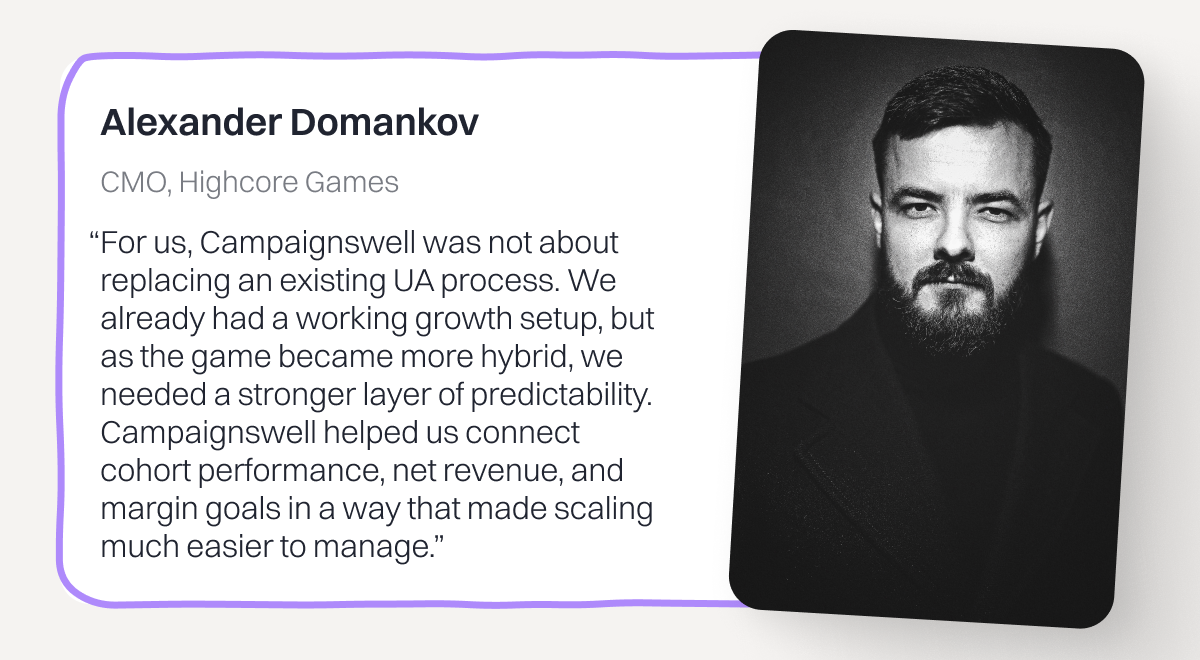
Within that broader shift, Campaignswell helped Highcore manage growth with more confidence. After adopting the platform, Highcore roughly doubled monthly spend and reported around 30% growth in margin profit, while also improving the predictability of planning.
The key result was not just higher spend. The bigger change was that growth became easier to manage. The team could plan budget ranges more calmly, understand how marketing activity was likely to develop, and align UA decisions with margin goals instead of relying only on delayed cohort results.
How Highcore uses Campaignswell today
Today, Campaignswell is one of Highcore’s key tools for UA decision-making. The team uses it to monitor campaign performance, evaluate young cohorts, validate results, review unexpected cohort behavior, and plan budgets for upcoming periods.
Highcore still uses MMP and other tools as part of the stack, but Campaignswell brings normalized revenue, cohort-level predictions, and practical UA views into one place. That makes it easier to understand campaign health, compare performance across cuts, and make decisions earlier.
The collaboration also continues beyond standard dashboards. Highcore works with Campaignswell on more complex reporting cases, including retargeting and reattribution. As more tasks are solved inside the platform, the team’s trust in the workflow grows.
“Campaignswell gives us a much clearer view of how different cohorts, campaigns, and creatives are developing. We can compare predicted revenue curves earlier, understand whether performance fits our KPIs, and make faster decisions on where to scale or reduce spend.”
How Campaignswell turns user behavior into budget decisions
Campaignswell is an analytics and forecasting platform built for UA, performance marketing, and growth teams that need to make budget decisions before all cohort data has fully matured.
Campaignswell brings marketing, product, attribution, spend, and revenue data into one place, so teams can see both actual performance metrics and predictive metrics in clear dashboards: real spend, revenue, CAC, ROI, cohort performance, creative performance, plus forecasted LTV, ROAS, payback, and revenue. Basically, the stuff you need when “let’s wait another three weeks” sounds less like analysis and more like an expensive hobby.
The core difference is how Campaignswell builds predictions. The model does not simply look at historical averages and assume the future will politely behave the same way. It analyzes real user behavior inside cohorts, reads multiple behavioral and monetization signals, and adapts the model to each client’s product, traffic mix, monetization logic, geos, and platforms. So the output is not a generic historical forecast wearing a nice dashboard costume. It is a client-specific prediction layer based on how users are actually behaving right now.
Campaignswell works like a growth control panel: independent analytics, normalized net revenue, cohort-level predictions, creative-level visibility, and faster answers without building an internal BI system from scratch.
If hybrid monetization made your cohort payback harder to predict, Campaignswell can help you see where to scale earlier.
Book a demo and let’s walk through your case together.
[[ctaform1]]

Co-founder & CEO at Campaignswell
Book a demo


Co-founder at Campaignswell
Use the session to ask your hardest questions about scaling, LTV, or attribution, and see how full-funnel predictive analytics gives you clear, actionable answers.







.webp)