
How Talaboos scaled from launch to $1M/mo ad spend in six months with predictive LTV analytics

Before
- Talaboos was just launching and had no analytics infrastructure in place yet
With Campaignswell
- Built analytics into the growth process from day one, without creating an in-house BI team
- Used predictive LTV to evaluate campaigns, creatives, traffic sources, and geos early
- Reached $800K–$1M in monthly ad spend in less than 6 months
- Supported 7 active products with one centralized analytics system
- Tested 100–120 creative hypotheses every week
- Increased subscriber LTV by 20–25% through monetization analysis
About Talaboos
Talaboos is a fast-growing portfolio company focused on <highlight-pink>subscription-based B2C products in the microlearning space<highlight-pink>. The team launched the business in late 2025 and spent the first months building the infrastructure needed for scale: assembling the team, setting up acquisition processes, connecting core technology partners, and creating the operational foundation for growth.
Today, Talaboos operates <highlight-pink>7 active products<highlight-pink>, with two flagship products driving most of the acquisition volume. The company currently <highlight-pink>spends $800,000–$1,000,000 per month<highlight-pink> on user acquisition across its portfolio. All acquisition is driven through <highlight-pink>web funnels<highlight-pink>, which gives the team flexibility to test, optimize, and scale quickly across multiple products and geographies.
The company reached this scale in less than six months. The team attributes that growth to three factors:
- deep performance marketing experience gained from previous ventures,
- an aggressive experimentation culture with 100–120 creative hypotheses tested every week,
- and access to predictive LTV analytics that helps them make scaling decisions long before revenue data fully matures.
To understand how Talaboos built a multi-product growth engine that reached nearly $1 million in monthly ad spend within months of launch, we sat down with the team to learn how they approached analytics, experimentation, and scale from day one.
The scaling challenge
Performance marketing sits at the center of Talaboos’ business model. With multiple products, subscription monetization, and aggressive scaling targets, the team needed a reliable way to understand marketing performance, forecast LTV, and make acquisition decisions with confidence.
“In a subscription business, we can’t wait for cohorts to fully mature before making decisions. We need to understand as early as possible whether a campaign, product, or traffic source is likely to generate the kind of LTV we’re looking for. That’s why predictive LTV is important for us. It gives us a signal we can use while we’re scaling, instead of waiting months for the complete revenue picture.” — Dmitry, Co-founder at Talaboos
The team needed:
- Marketing analytics across channels, products, creatives, and geographies
- Reliable LTV forecasting
- Cohort analysis for long-term revenue evaluation
- Faster decision-making without building a dedicated analytics function
- A system capable of supporting rapid experimentation at scale
Why Talaboos chose Campaignswell over building an in-house analytics team
To get the level of analytics they needed for aggressive scaling, Talaboos had two options: build an in-house analytics function from scratch or adopt an existing solution. Having built analytics teams in previous companies, the founders understood exactly what an internal build would require: months of hiring, infrastructure development, model validation, and ongoing maintenance before the system could reliably support growth decisions.
Campaignswell provided the functionality the team needed from day one, allowing them to focus on growth instead of analytics development.

Another important factor was <highlight-pink>predictive LTV modeling<highlight-pink>. The team wanted forecasting capabilities immediately rather than spending months collecting enough data to build and validate their own prediction models.
“When you’re scaling several products at the same time, you need to understand very quickly where the best economics are. That’s where predictive analytics becomes especially valuable.” — Dmitry, Co-founder at Talaboos
Campaignswell delivered both: <highlight-pink>ready-to-use analytics and predictive insights that could support acquisition decisions from the start.
How Talaboos uses Campaignswell daily
Campaignswell became a central decision-making tool across both UA and leadership teams.
The UA team uses predictive LTV and profitability metrics to evaluate creatives, campaigns, traffic sources, and geographies before large amounts of budget are committed. Forecasts help determine which segments deserve additional investment and which require closer attention.
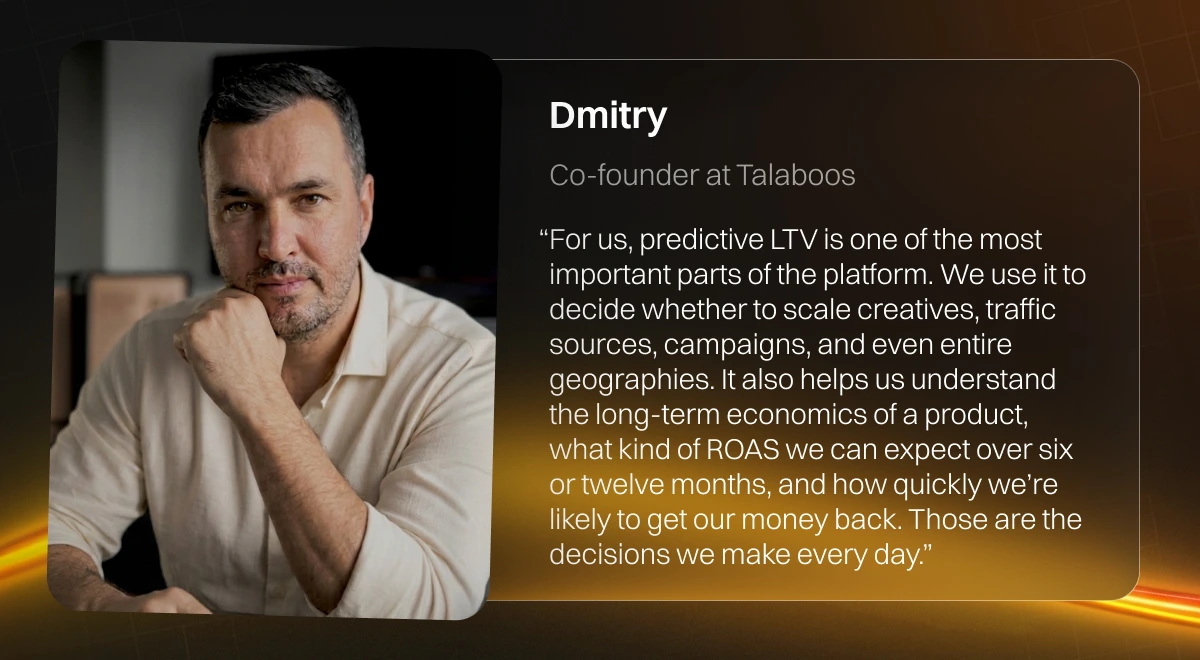
At the management level, Campaignswell provides a consolidated view of long-term business performance. The team analyzes expected LTV, projected ROAS, payback periods, and cohort quality to evaluate scaling opportunities across the entire portfolio.
“If the analytics show that the economics work, scaling becomes a technical task.” — Dmitry, Co-founder at Talaboos
The company currently <highlight-pink>tests 100–120 creative hypotheses every week<highlight-pink>, making fast feedback loops essential for efficient budget allocation and creative iteration.
Using MCP to get faster answers from marketing data
MCP has become a faster way for the Talaboos team to talk to their performance data directly. Instead of manually digging through dashboards every time the team needs an answer, UA managers can ask the model questions like how yesterday’s traffic performed or which creatives worked well or poorly, and get a summarized answer quickly.
“The main use case is that: the team connects MCP, asks questions like how yesterday’s traffic performed or which creatives worked well or poorly, and gets a quick summarized answer. It saves a lot of time and highlights things a person might miss manually.” —Dmitry, Co-founder at Talaboos
The team also sees MCP as a way to combine Campaignswell data with other sources, such as Stripe or web analytics. This makes it easier to investigate more specific issues, for example why payment acceptance rates dropped or why a certain segment stopped converting as expected.
Key insights uncovered through Campaignswell
When we asked the Talaboos team which insights from Campaignswell had been the most valuable, they said it was hard to pick just a few because the platform shapes their decisions every day. Still, several examples stood out.
The team discovered that prepaid cards generated a meaningful share of trial subscriptions but converted into paying subscribers at significantly lower rates. After identifying the issue through Campaignswell, Talaboos disabled prepaid card payments in Stripe and retrained its optimization datasets, <highlight-pink>improving the quality of incoming cohorts<highlight-pink>.
Geography was another area where the data challenged existing assumptions. Campaignswell revealed that traffic from the US was converting noticeably worse than the rest of the company’s Tier-1 markets. <highlight-pink>That insight changed how the team approached media buying<highlight-pink>: today, US traffic is measured against its own performance targets and managed separately from other Tier-1 geos.
One of the biggest wins came from subscriber monetization. Campaignswell gave the team visibility into how different A/B-tested monetization flows paid back over time, helping Talaboos <highlight-pink>increase subscriber LTV by 20–25%<highlight-pink> while improving payback performance.
The growth impact
<highlight-pink>Within six months of entering active scale mode, Talaboos grew into a multi-product business spending close to $1 million per month on acquisition. <highlight-pink>
Campaignswell helped the team:
- Launch with enterprise-grade analytics without building an internal BI department
- Make scaling decisions using predictive LTV rather than delayed revenue signals
- Get full-funnel visibility across web funnels, connecting acquisition data, trial performance, subscription revenue, and long-term LTV in one place
- Analyze creatives with granular performance views and early payback signals.
- Identify low-quality prepaid card cohorts and improve optimization datasets
- Isolate underperforming US traffic and apply dedicated acquisition benchmarks
- Increase subscriber LTV by 20–25% through long-term monetization analysis
For a company operating at high speed across multiple subscription products, access to predictive analytics has become a competitive advantage. Instead of spending months building infrastructure, Talaboos invested that time into launching products, testing ideas, and scaling what works.
About Campaignswell
Campaignswell is <highlight-green>a predictive analytics platform built for performance marketing teams that need answers before revenue fully matures <highlight-green>.
Instead of waiting weeks or months for subscription cohorts to reveal their true value, Campaignswell helps teams <highlight-green>understand future performance from early user behavior<highlight-green>. The platform analyzes signals across onboarding, subscriptions, payments, renewals, retention, refunds, and cohort activity to predict future LTV, ROAS, ROI, and payback periods while campaigns are still young.
Campaignswell combines acquisition, attribution, product, and revenue data into a single analytics layer, allowing teams to evaluate campaigns, creatives, funnels, channels, and geographies using both actual and predicted business outcomes.
Unlike traditional forecasting models that rely primarily on historical averages, Campaignswell <highlight-green>continuously updates predictions as new behavioral and revenue signals arrive<highlight-green>. Every cohort is re-evaluated daily, helping teams spot changes early and make faster budget allocation decisions.
The platform's machine learning <highlight-green>models are calibrated to each company's business model, monetization structure, traffic mix, and customer behavior patterns<highlight-green>. This allows growth teams to identify high-value cohorts, forecast long-term revenue, and scale acquisition with greater confidence long before complete revenue data becomes available.
If you also want to save months of analytics work and start scaling faster, book a demo.
We'll show you exactly how predictive LTV and early cohort signals can work in your business.
[[ctaform1]]

Co-founder & CEO at Campaignswell
Book a demo


Co-founder at Campaignswell
Use the session to ask your hardest questions about scaling, LTV, or attribution, and see how full-funnel predictive analytics gives you clear, actionable answers.








.webp)