
From 12 to 28 apps & web2web products: How Cacao Mobile scales with predictive analytics
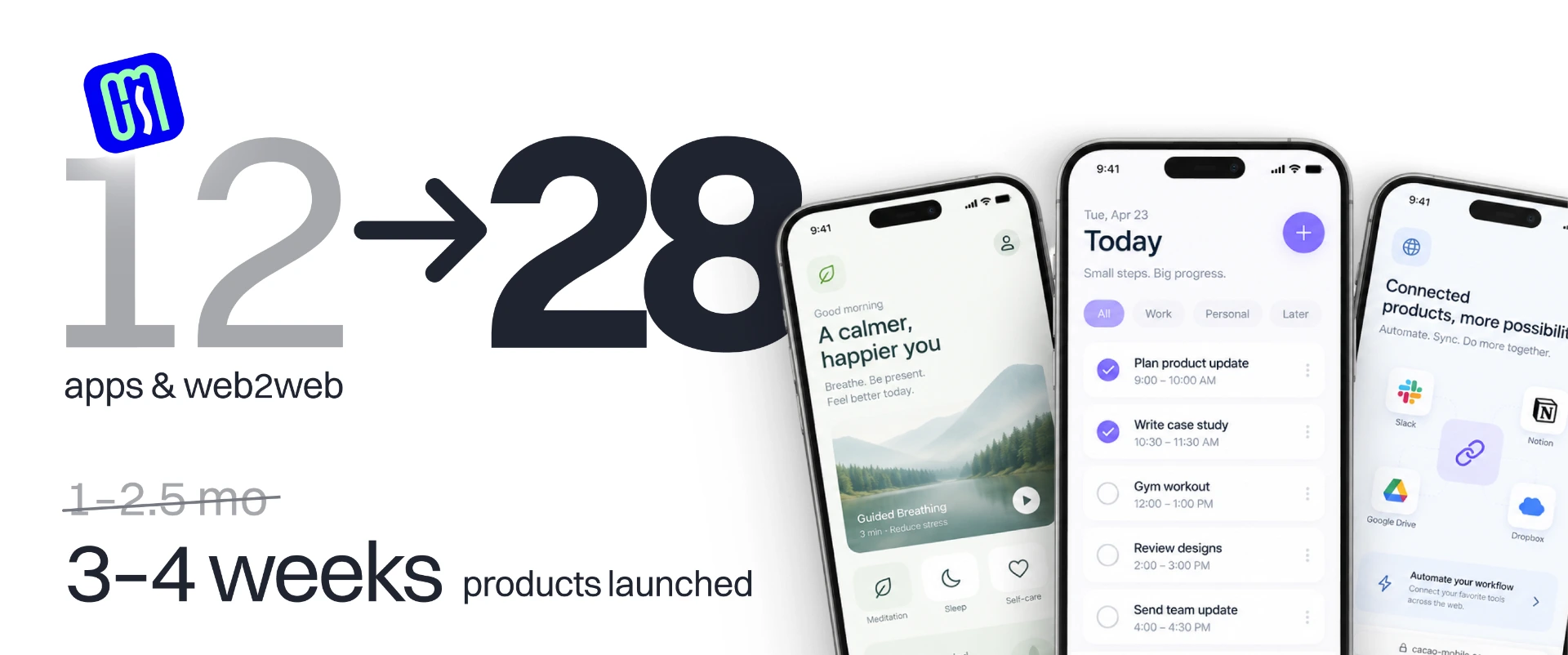
Cacao Mobile runs a fast-growing portfolio of 28 active products across several categories, with three development teams and a lean analytics function supporting the entire operation.
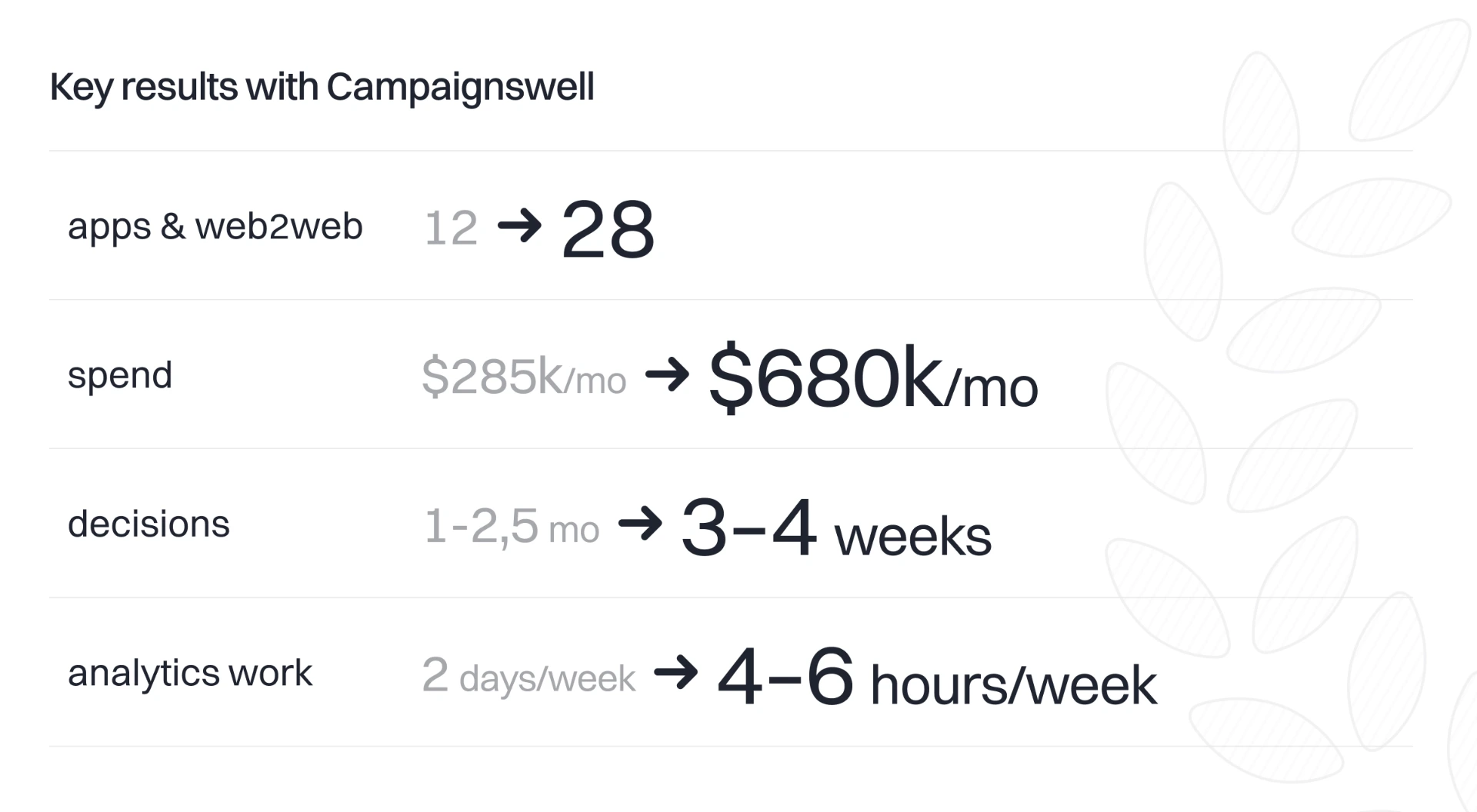
Between October 2025 and July 2026, the company grew monthly acquisition spend from $285K to $680K, with web-to-web products alone reaching $260K. At the same time, the team expanded from managing around 12 products at once to 15 app products plus 13 web-to-web projects, while cutting recurring analytics work from roughly two full days a week to just 4–6 hours.
Campaignswell helped Cacao support that growth with faster access to the numbers behind each investment decision, from evaluating new products and reallocating budget to planning web-to-web spend and monitoring long-term profitability.
Today, the team can start getting reliable predictive signals for new iOS products within 3–4 weeks and use them to decide where there is enough potential to keep investing.
Before Campaignswell: data was there, but the decision layer was missing
Before Campaignswell, Cacao already used different tools for different parts of the funnel. AppsFlyer covered attribution and could track revenue and subscriptions, while tools like RevenueCat or Mixpanel could provide deeper product analytics.
The problem was that these tools showed what was happening without giving the team the predictive layer needed to understand whether an app was likely to generate enough long-term value to justify more spend.
That became especially difficult across a portfolio of very different products with their own user behavior, retention patterns, monetization models, and levels of maturity.
.webp)
Without Campaignswell, investment decisions were either made earlier than the team would have liked or delayed while the economics were calculated in Google Sheets or through a custom BI setup. When a product showed potential, reaching a confident decision could take anywhere from 1 to 2,5 months.
Cacao needed a practical BI that could connect current performance with predicted economics and deliver useful answers fast.
.webp)
The real advantage is making more decisions with the same lean team
Cacao’s use of Campaignswell has grown alongside the business.
- Monthly acquisition spend rose from $285K in October 2025 to $680K in July 2026.
- Web-to-web alone reached $260K in monthly spend.
- The number of products the team can actively evaluate expanded from around 12 to 15 app products plus 13 web-to-web products, while the analytics function remains one person.
- Recurring analytics work fell from around 2 full days a week to 4-6 hours.
- New iOS products can begin producing actionable predictive signals within roughly 3-4 weeks when enough data is available.
For Cacao, those changes all support the same operating model: launch products, understand their economics early, put more resources behind the ones with room to grow, and keep a much larger portfolio moving without building a large internal BI organization.
From 12 to 28 products managed simultaneously
Before Campaignswell, Cacao typically worked with around 12 products at once, including 5 to 7 larger ones.
Today, the team simultaneously manages 15 app products, including 7 large products, alongside 13 web-to-web products, 5 of which operate at larger scale.
Detailed breakdowns, predictive analytics, and easier integrations for new products and traffic sources make it possible to evaluate the economics of a much broader portfolio without rebuilding the analysis for every launch.
This matters as much as the speed of an individual decision: Cacao can keep more opportunities moving through the growth process at the same time.
.webp)
Predicted revenue stays within 5–15% of mature cohort results
Cacao has several high-volume iOS products where early forecasts can now be compared with months of actual cohort performance.
For Heart Rate, which brings in more than 5,000 new payers a month, the projected revenue for a monthly cohort typically adjusts by only around 5–10% over the following 2-3 months.
QR Code shows a similar pattern with more than 2,000 new payers per month, with revenue forecasts generally refining by around 5–10%.
For Calory Counter, which acquired more than 13,000 new web users and scaled to $500,000 in just three months while maintaining an average ROI of 30–40%, the results demonstrate strong, sustainable performance even at significantly higher volumes.
These mature products give the team an ongoing way to see how predicted economics develop as actual renewals and revenue come in, while newer apps can start benefiting from the forecast much earlier in their lifecycle.
Analytics work dropped from 2 days a week to 4–6 hours
The impact is visible beyond budget decisions.
Before the current setup was fully established, analytics and economic calculations required around 2 full working days every week. That included exporting data from multiple sources and reconciling it across creatives, campaigns, countries, and other dimensions.
After the integrations, setup, validation, and fixes were completed during the transition period from November 2025 through January 2026, the same type of work now takes around 4-6 hours of focused time per week, including occasional checks against other sources.
Spreadsheets have not disappeared entirely, but they are now used mainly for verification rather than as the primary way to assemble the performance picture.
For an analytics function of one person supporting this portfolio, that difference leaves much more time for actual analysis instead of data preparation.
.webp)
Creative analysis moved out of manual exports
The creative workflow has become less manual as well.
Cacao’s creative producer previously had to export Meta performance metrics by hand. With creative-level data available in Campaignswell, the team can review those metrics directly alongside the rest of its acquisition performance.
That removes another recurring reporting step and gives marketers a quicker path from creative performance to the broader campaign and revenue context.
Web-to-web grew to $260K in monthly spend inside the same analytics setup
Web funnels have become a much larger part of Cacao’s acquisition mix.
By July 2026, web-to-web products accounted for around $260K of the company’s $680K monthly acquisition budget.
Predictive analytics has made it easier for the team to plan those budgets and bring new web-to-web projects into the existing analytics workflow quickly. Funnel and payment data can be connected alongside the rest of the portfolio instead of requiring a separate BI setup each time a new web product launches.
This gives Cacao a consistent way to evaluate economics as its mix expands across iOS, Android, and web.
.webp)
Predictive LTV helps Cacao decide what to scale within weeks
With Campaignswell in place, Cacao can use the same decision framework across released products and media sources, looking at current cohort performance together with predicted LTV and profitability to understand whether the economics support further investment.
For new iOS apps, the forecast can become actionable around 3–4 weeks after launch when there is enough data, which for Cacao typically means about $1K in weekly spend and at least 50 payers. A broader decision to scale, keep iterating, or deprioritize the product usually follows within 4–6 weeks, while an established product can be evaluated on a new media source in roughly 3–6 weeks.
Android requires more time because the forecast depends more heavily on product-specific signals such as rebills, active-user share, declined payments, and subscription intent. In Cacao’s experience, the model may continue calibrating for 1–1.5 months, with around 50–100 payers per week giving the team a stronger basis for subsequent decisions.
The biggest change is that Cacao no longer has to choose between acting too early and waiting weeks for manual calculations. Once the forecast is strong enough, the team can decide where to increase spend, where to keep testing, and where to move budget elsewhere.
For iOS products and web-to-web funnels, that confidence has made budget allocation faster and more deliberate. As monthly acquisition spend grew from $285K to $680K, predictive analytics helped Cacao plan budgets, redistribute spend across the portfolio, and bring new web-to-web projects into the mix more easily.
.webp)
MCP with Claude opened another way to work with campaign data
More recently, Cacao has started using an MCP workflow with Claude on top of its Campaignswell data.
For a team managing a large number of advertising campaigns, this makes it faster to explore performance from different angles, build dashboards, and look for patterns that may be difficult to spot through a fixed reporting workflow.
The team points to this as one of the newer Campaignswell use cases with a particularly noticeable impact on how quickly it can work through large volumes of campaign data.
Why Cacao chose Campaignswell over building in-house
Cacao had another option: build the analytics and predictive layer internally. The team understood what a good custom BI could offer, but also knew how much infrastructure sits behind it.
A system like this would need to ingest and maintain data across multiple products, ad platforms, payment providers, and funnels while supporting predictive models for apps with very different user behavior and monetization. Every new integration adds more work, and web introduces another set of data sources to maintain.
.webp)
Campaignswell gave Cacao the predictive BI layer it needed without turning analytics infrastructure into another large internal project.
Today, Cacao’s analytics function consists of just one person, yet the platform is used daily by a significant part of the team, including UA and product managers, a creative producer, and the analyst. It greatly simplifies calculations and enables near-real-time decision-making across a growing product portfolio and hundreds of thousands of dollars in monthly acquisition spend.
Want to know what to scale before the full revenue curve catches up? Book a demo.
We’ll walk you through the predictive models behind Campaignswell, already used to allocate $400M+ in ad spend, with 1M+ model parameters and 95% prediction accuracy across 93% of clients.
[[ctaform1]]

Co-founder & CEO at Campaignswell
Book a demo


Co-founder at Campaignswell
Use the session to ask your hardest questions about scaling, LTV, or attribution, and see how full-funnel predictive analytics gives you clear, actionable answers.






.webp)