
Why your subscription app can’t break the $100K/Month ceiling without losing revenue


Hey, Artsiom here, CEO at Campaignswell, a SaaS BI for perfomance marketing.
Over the last few years, I’ve spoken with more than 500 app founders and worked closely with dozens of subscription products at very different stages. The products, teams, and markets vary a lot, but the pattern I keep seeing is surprisingly consistent.
Up to a certain point, most setups work just fine.
<highlight-green>When monthly spend sits up to $100K<highlight-green>, you can usually get by with a fairly improvised analytics stack. Attribution from your MMP is good enough. You pull numbers from a few ad dashboards, reconcile revenue manually, build rough LTV predictions in Google Sheets, and move on.
The process is not elegant, but the financial impact of small inaccuracies is limited. Even if something is slightly off, it rarely becomes expensive.
<highlight-green>As soon as you decide to seriously scale spend (and you will!) all the cracks show at once.<highlight-green>
- What used to be “good enough” attribution stops holding under volume.
- Small discrepancies between platforms no longer cancel each other out, they accumulate.
- Timing differences, currency mismatches, refunds, renewals, and attribution gaps start turning into material sums of money.
- Manual reconciliation becomes a bottleneck.
- Spreadsheet-based forecasts lag behind reality.
Teams start reacting late, pausing campaigns that might have paid back, or scaling ones that only looked healthy on the surface.
As a result, <highlight-green>many teams do increase spend, but revenue doesn’t follow in the same way.<highlight-green>
How this breaks in real life
Let me give you <highlight-pink>a real example from one of our clients.<highlight-pink>
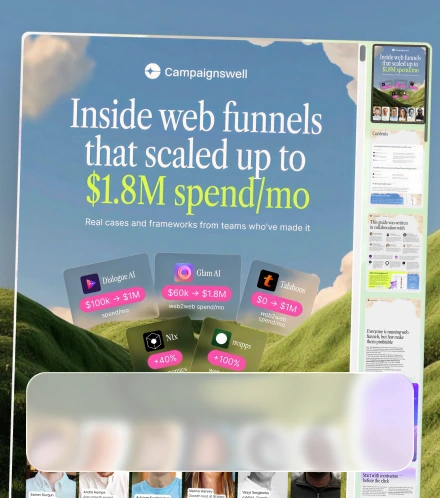
The AI companion app Dialogue team was actively scaling paid acquisition across mobile and web while relying on several separate systems to evaluate performance. Ad platforms, MMP attribution, and subscription revenue all lived in different tools and showed different pictures of the business.
To make decisions, the team manually reconciled data across dashboards, which took time and still left uncertainty due to attribution gaps, subscription delays, refunds, and renewals. <highlight-pink>As monthly spend approached around $100K, this setup stopped scaling.<highlight-pink> Revenue insights lagged behind spend, and decisions had to be made without timely visibility into real subscription payback.
They had ambitious plans to keep scaling and reached a decision point: either hire analysts and start building an in-house BI, or look for an alternative that wouldn’t slow growth down.
The problem and the choice the Dialogue team faced are typical. With every single client we work with — fitness apps, AI companions, VPNs, utilities — the story starts the same way. The moment a team really starts scaling and crosses roughly $100K in monthly paid spend, the comfortable picture breaks.
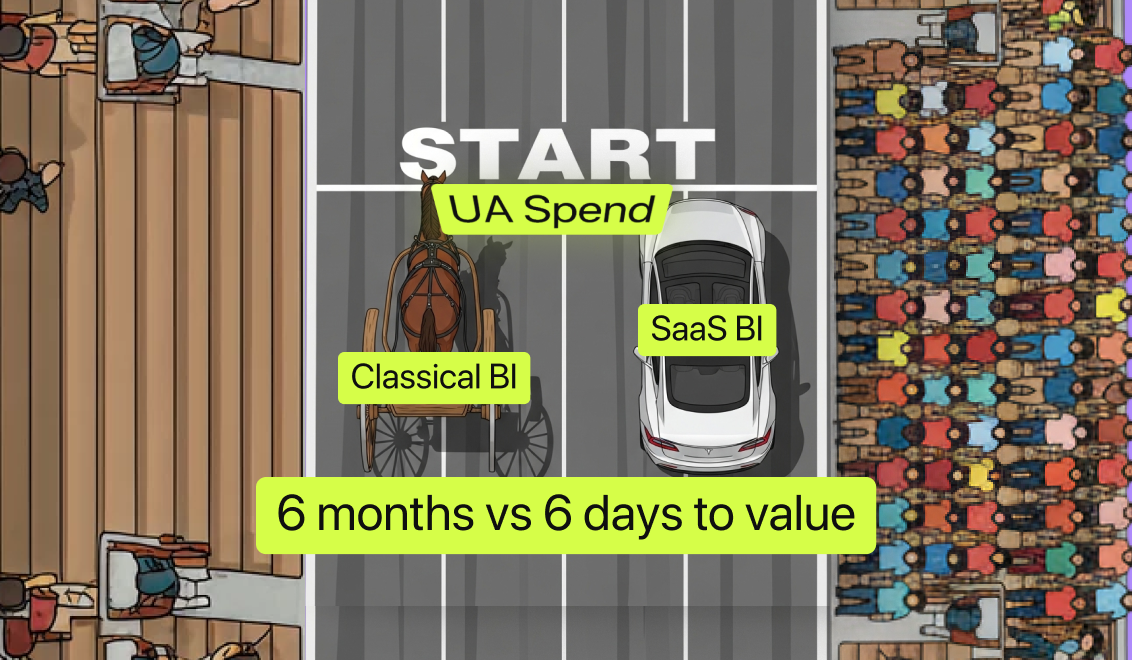
Why in-house BI isn’t an ideal solution for fast scale
This is the point where many teams start thinking: <highlight-green>maybe we need our own BI.<highlight-green> Sure, they need an accurate, current view of what’s really happening in the business, easy to work with in a single dashboard, along with reliable ROAS, LTV, and revenue predictions they can actually trust.
But not every startup can afford to spend a year and a million dollars building an in-house BI system with no guarantee that it will actually meet the business’s needs. Because a BI setup that looks perfect from an engineering perspective often turns out to be far from ideal for day-to-day business decisions.
What changes with a setup built for scale
So how did the Dialogue team handle this dilemma?
They ran the numbers and realized <highlight-green>it made more sense to use a SaaS BI and keep scaling now<highlight-green>, rather than spend time and resources building an in-house system. Growth was already moving, and pausing it for a year to build internal infrastructure didn’t feel like a smart tradeoff.
That’s how they came to Campaignswell.
As a result, they got:
- A single source of truth across mobile and web, with one timezone, one currency, and revenue validated against real payments.
- A clear connection between spend and subscription revenue, without daily manual reconciliation across dashboards.
- Usable revenue and LTV predictions that could be compared to actual outcomes and relied on for scaling decisions.
- Readiness to scale web funnels, with landing-level LTV, early churn signals, and faster payback insights across dozens of experiments.
- Correct cross-platform attribution, including users who entered via web and converted in the app, tracked within one funnel.
- One shared performance view for the in-house team and agencies, reducing disagreements and speeding up decisions.
- Better control over iOS traffic, using modeled and recovered attribution where direct data was missing.
With unified data and predictive modeling in place, <highlight-green>the company scaled monthly spend from $100K to $1M, while achieving 10× growth in revenue, subscribers, and profit within one year.<highlight-green>
[[ctaform1]]
<highlight-green>Campaignswell is a SaaS BI built specifically for performance marketing in subscription businesses.<highlight-green>
It was created by people with deep backgrounds in applied math, fintech, and mobile analytics who had seen firsthand how growth decisions end up relying on fragmented data and delayed signals.
Campaignswell gives CEOs a clear, actionable view of spend, revenue, and payback at the moment scale starts to matter, without adding friction to the business.
If you’re at that stage and want clear visibility into what’s actually driving growth, I’m happy to walk you through it on a quick demo.
Feel free to book it here.
Your next $50K Ad spend shouldn’t be a guess

Co-founder & CEO at Campaignswell
Book a demo


Co-founder at Campaignswell
Use the session to ask your hardest questions about scaling, LTV, or attribution, and see how full-funnel predictive analytics gives you clear, actionable answers.





71 takeaways mobile app publishers can use to improve monetization strategy and LTV
10 monetization mistakes that hold back subscription apps